01
Gemini 4 Hydrogen is live for everyone
Google's new fast Gemini 4 model is in Search, the Gemini app, and the API today, at a flat $1.50 / $7.50 per million tokens.
What they showed / shipped
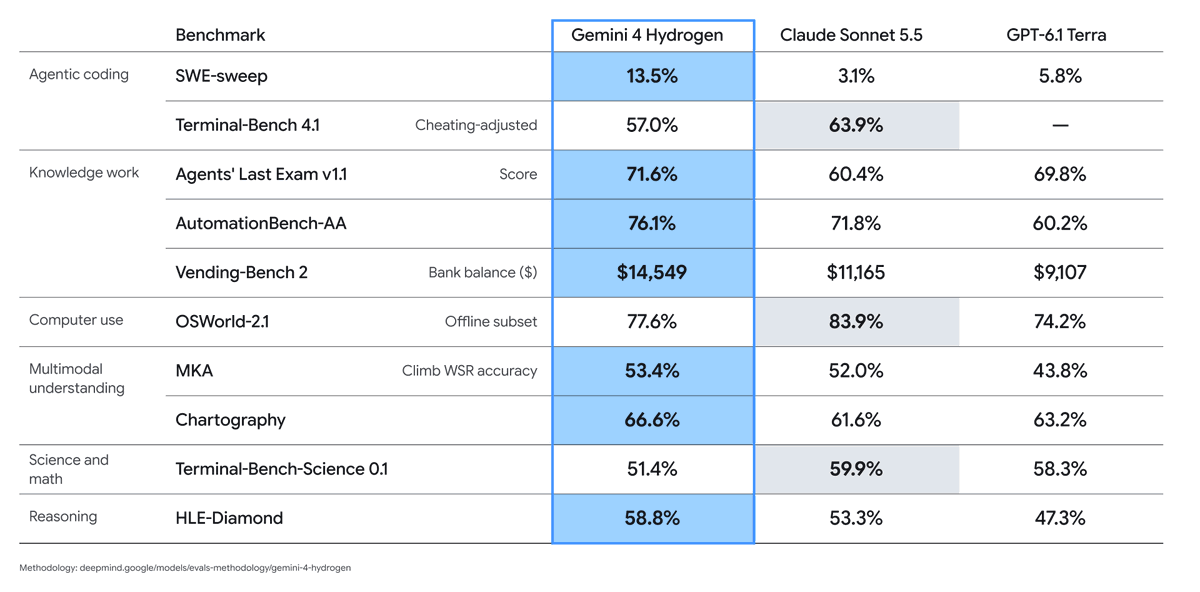
- Google DeepMind launched Gemini 4 Hydrogen, a fast everyday model for coding, multimodal work, and agent workflows. It says the model finishes tasks 2.5x faster than 3.8 Flash at its default high thinking setting, and that it surpasses Gemini 4 Argon on the Artificial Analysis Intelligence Index (51 vs 50, or 54 at the new xhigh setting) Google DeepMind on X.
- Demis Hassabis posted the Google blog and called it a model for everyday coding, agentic work, and all-round use Demis Hassabis on X.
- Pricing is flat across the full 1 million-token context window: $1.50 per million input tokens and $7.50 per million output tokens. Hydrogen has four thinking levels (low, medium, high as the default, and a new xhigh tier). Google says it is rolling out in AI Studio, the Gemini API, Gemini for business, the Gemini app, Google Search, and Google Antigravity for paid AI Pro and Ultra users. Free Gemini app users get it through auto model selection when it fits the prompt.
- In Google Antigravity, a new Orchestrator option can switch between Hydrogen and Gemini 4 Carbon in one session. Google says that on Terminal-Bench 4.0, Orchestrator reached near-Carbon success rates while using 24% less quota and finishing 19% faster on average Antigravity blog. As a standalone model, Hydrogen scores 57% on Terminal-Bench 4.1 vs 18.2% for 3.8 Flash. Those are first-party numbers.
- Search is also getting Hydrogen: Google and The Verge both describe better handling of messy, multi-part questions and more visual answers The Verge.
Why it matters
- This is the model you can actually try today, not a waitlist drop. The price is simple, the context window is huge, and Orchestrator is the first official 'use the smart model to plan, the fast one to execute' switch inside Google's own IDE.
- Keep the caveat on screen: the speed, benchmark, and Orchestrator savings numbers are Google's own.
Sources
02
Gemini glasses start at $395
Google, Samsung, Warby Parker, and Gentle Monster opened preorders today for Gemini smartglasses with no lens display, starting at $395 and shipping December 10.
What they showed / shipped
- The first Gemini-powered smartglasses are up for preorder today. They are a collaboration between Google (software), Samsung (the compute hardware in the frames), and two eyewear brands. Warby Parker frames start at $395 in the US; Gentle Monster styles start at $449 in the US and South Korea. Devices are due to ship and hit stores on December 10 Ars Technica.
- Demis Hassabis called glasses one of his favorite Gemini integrations Demis Hassabis on X.
- There is no screen in the lenses. You talk to Gemini by voice or a tap, with open-ear speakers and a 12 MP camera. Google pitches glance-and-ask uses (a bookshelf, an event poster, Maps guidance) plus Gemini Guided Vision for people who are visually impaired. Launch support is narrow: iPhone 13 Pro and newer, Pixel 7 or newer, or a Samsung Galaxy S or Z phone on One UI 9 or later.
- Google is leaning on privacy features: a recording light that disables the camera if it is covered, a physical off switch, no live streaming apps, no real-time facial recognition, faces redacted before video is sent to Google, and a claim that glasses captures will not go into Gemini history, model training, or ad targeting. Voice chats do not get that same guarantee. Data is encrypted on the device and in transit, but not on Google's servers; the company says it is working to bring Private AI Compute to the glasses.
Why it matters
- This is the 'where AI lives next' beat. A $395 Gemini pair, even without a display, is a real attempt to put the assistant on your face after years of Ray-Ban Meta glasses owning that slot.
- Price is a starting point before prescription lenses, and the phone compatibility list is short at launch.
Sources
03
Inkling 2 Small and Decider v1.3 go open
Thinking Machines put 594B Inkling 2 Small weights on Hugging Face under Apache 2.0, and Perplexity open-sourced Decider v1.3 the same day.
What they showed / shipped
- Thinking Machines Lab says Inkling 2 Small's weights are now downloadable on Hugging Face under Apache 2.0, after a November 5 launch that had kept the weights closed pending safety testing Thinking Machines on X. The model is a mixture of experts with 594 billion total parameters and 17 billion active, plus image input, a 1 million-token context window, and a first-party Artificial Analysis Intelligence Index score of 31 Thinking Machines blog.
- This is not a laptop model. The lab's model card says the main NVFP4 checkpoint needs at least 500 GB of aggregated VRAM, for example 2 NVIDIA B300s or 4 H200s. It is also wired into Unsloth, SGLang, vLLM, and TokenSpeed, and available through several inference APIs.
- Separately, Aravind Srinivas said Perplexity is open-sourcing Decider v1.3 and Decider Flash v1.3, with weights on Hugging Face and a week of free access on OpenRouter. The new v1.3 capability is locate: you describe what to find, and the model returns the matching text with character offsets. Perplexity says the models beat the best general extraction model it tested on 17 out-of-domain NER, PII, and extractive QA tasks, and that v1.3 is 6.54 points more accurate than the classifiers it runs today on 63 of its own production classification tasks Aravind Srinivas on X.
- The Perplexity blog adds that both models are Apache-licensed, available through the Decisions API, and built to return probabilities for classification, routing, and rubric scoring rather than a chat reply.
Why it matters
- Two real download paths in one day. Inkling 2 Small is a frontier-scale open MoE if you have a small GPU cluster. Decider v1.3 is the one most people can actually try this week, especially with the free OpenRouter window.
Sources
04
40% of game studios now use gen AI at work
A new GDC survey of more than 2,600 game professionals puts generative AI use on the job at 40%, even as 55% still say it is bad for games.
What they showed / shipped
- The GDC Festival of Gaming's 15th State of the Game Industry survey (more than 2,600 professionals) found that 40% now use generative AI tools as part of their job, up from 36% last year. Usage is 58% among people working on free-to-play games and 70% at mobile-only studios. 57% of those adopters use it daily The Verge.
- The most common uses are research and brainstorming (73%), data analysis and summarization (62%), and code generation and debugging (56%). Only 8% said they use it for production art or final game assets. 55% still say generative AI has a negative impact on games.
- a16z published a related games essay arguing AI lets lean teams attempt more, including mods and riskier original IP a16z on X.
- 📌 On the radar: Runway added native 3D with Tripo H3.1, so you can generate a model from text or an image, pick an angle as a video reference, and export it Runway on X.
Why it matters
- Put the 40% vs 55% split on screen. That tension is the story, not a victory lap.
- The Runway 3D switch is a real new tool in an app this brief already covered this week, so it stays as a one-line update, not its own topic.
Sources
05
Chinese frontier models carry a Blackwell fingerprint
A forensic study of public weights says six recent Chinese models were started on export-controlled NVIDIA Blackwell GPUs, and a lawmaker says NVIDIA privately agreed chip tracking is feasible.
What they showed / shipped
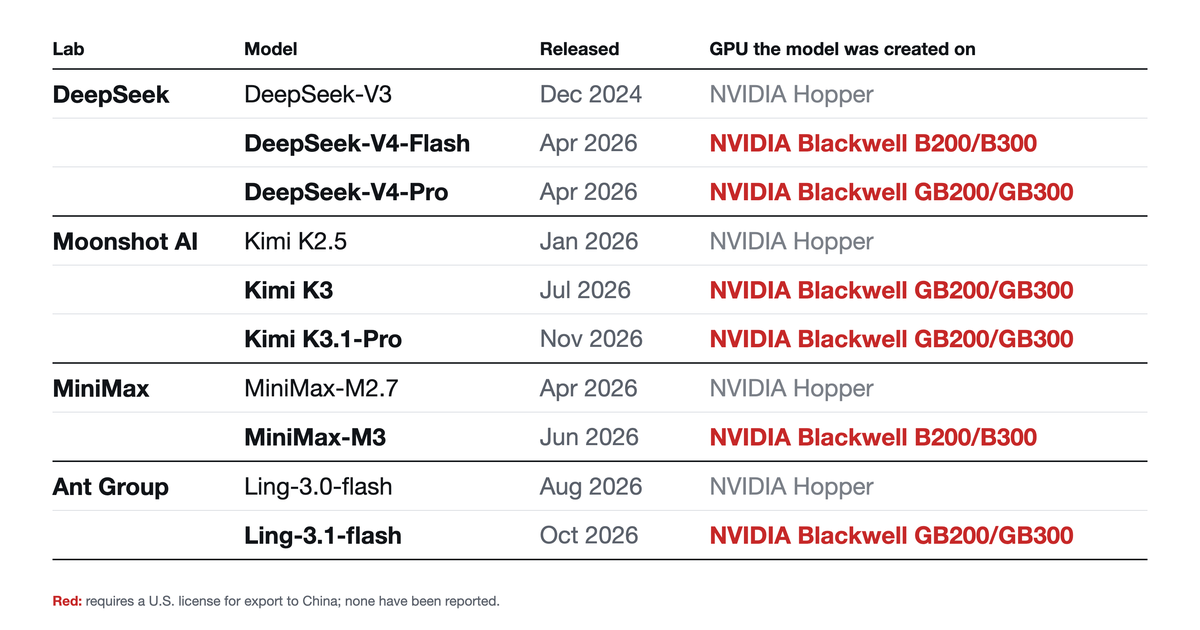
- Will DePue of Unemployment Labs analyzed published weights and reports that six models released since April 2026 from DeepSeek, Moonshot AI, MiniMax, and Ant Group carry numerical fingerprints matching NVIDIA Blackwell hardware, while earlier models from the same labs match Hopper. DeepSeek-V4-Flash and MiniMax-M3 match B200/B300 (148 SMs); DeepSeek-V4-Pro, Kimi K3, Kimi K3.1-Pro, and Ling-3.1-flash match GB200/GB300 (152 SMs). For DeepSeek-V4-Flash and Kimi K3, the author says the match was also confirmed on physical Blackwell chips Unemployment Labs.
- The paper is careful: the fingerprint supports, without proving, that Blackwell also performed the training. It does not establish where the chips were, how they were obtained, or whether export rules were broken. Specially configured AMD hardware is named as the only alternative considered; the author says that option is excluded for DeepSeek-V4-Flash and very unlikely for the other five.
- Separately, MIT Technology Review reports that NVIDIA representatives privately told US Rep. Bill Foster, a cosponsor of the Chip Security Act, that geotracking advanced AI chips would be technically possible, even as the Semiconductor Industry Association called similar mandates 'potentially infeasible.' NVIDIA did not comment. The same piece notes NVIDIA's Fleet Intelligence tool can indicate which country a customer's chips are in MIT Technology Review.
Why it matters
- This is a rare case where the evidence is in the weights themselves, not a leak. If the method holds, open checkpoints can reveal the hardware they were born on.
- Keep the limits on screen: this is one researcher's forensic write-up, and it does not prove smuggling or a training location.
Sources
06
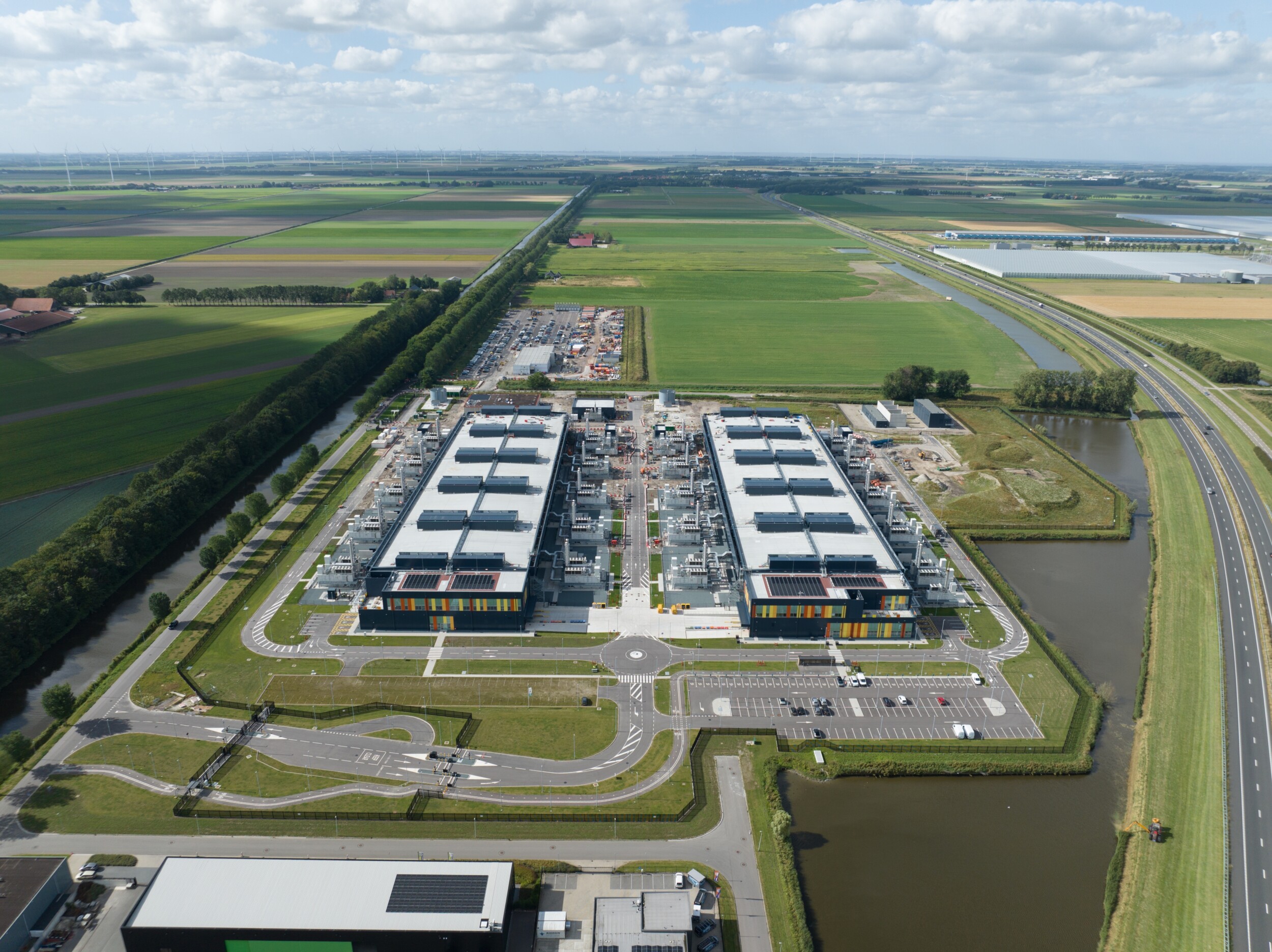
A new study undercuts data-center heat-island claims
A peer-reviewed paper on Japan's largest data-center cluster finds daytime cooling after facilities open, and says the viral +2 C claim would need 6 to 43 times more waste heat than the sites can produce.
What they showed / shipped
- A study now published in Environmental Research Letters tracked 13 years of satellite temperature data around 12 hyperscale data centers built between 2011 and 2025 in Japan's largest cluster, near Tokyo. After a facility came online, daytime land-surface temperature fell 1.8 to 2.2 C, a surface-materials effect. At night, when server exhaust should be easiest to see, cluster-scale warming stayed under 0.3 C IOP Publishing.
- Energy-balance math in the paper says producing the earlier claimed roughly 2 C regional warming would require 6 to 43 times more waste heat than the facilities can release.
- That earlier figure came from a widely covered, not-yet-peer-reviewed preprint (Marinoni et al., 2026) that reported about 2 C of average land-surface warming, up to 9 C, and heat exposure for roughly 340 million people, which CNN had amplified. This new paper is an ex-post, controlled satellite test of one major market, not a global rebuttal of every local air-temperature measurement.
Why it matters
- Builder and creator lens: this is a clean skeptic beat with a checkable mechanism. The viral number failed a basic energy budget, and 13 years of satellites over a real cluster show daytime cooling, not a 2 C heat island.
- Do not overclaim. Localized downwind air warming still shows up in other peer-reviewed field work, such as Phoenix transects. The teachable point is that a preprint plus a TV headline is not the same as a controlled energy balance.
Sources
07
Anthropic files to go public under the ticker ANT
Anthropic started its IPO roadshow with official Q3 numbers: $17.0B of revenue, more than 12x year over year, and a $23.3B net loss that is mostly a non-cash accounting charge.
What they showed / shipped
- Anthropic posted that it has filed a registration statement with the SEC for an initial public offering Anthropic on X. The official IPO site says the roadshow started November 10 (EST), the final share price is expected on November 18, and shares are expected to begin trading on Nasdaq on November 19 under the ticker ANT. Class A common stock is what is being offered. Underwriters named in the legal notice include Goldman Sachs and Morgan Stanley.
- Q3 2026 highlights on the same page: $17.0B of revenue, more than 12x year over year; more than 11,900 customers with at least $100K of trailing-twelve-month revenue, also more than 12x year over year (as of September 30, 2026); more than 4x compute-efficiency gain since Q1 2025 (revenue divided by compute and infrastructure expense); 15% adjusted operating margin; and a -3% operating margin.
- Net loss is listed at $23.3B. Anthropic says that figure includes a $21.9B non-cash charge from a change in the fair value of convertible notes, derivative liabilities, and SAFEs, tied to an increase in the company's valuation. Those are first-party figures from the IPO site, not a third-party leak.
Why it matters
- The useful part is the financial shape, not the ticker. Revenue is up more than 12x, adjusted operating margin is already positive, and most of the giant net loss is a paper charge from a higher valuation, not cash leaving the building.
- This is still a corporate filing. It does not change a model you can download today.
Sources
08
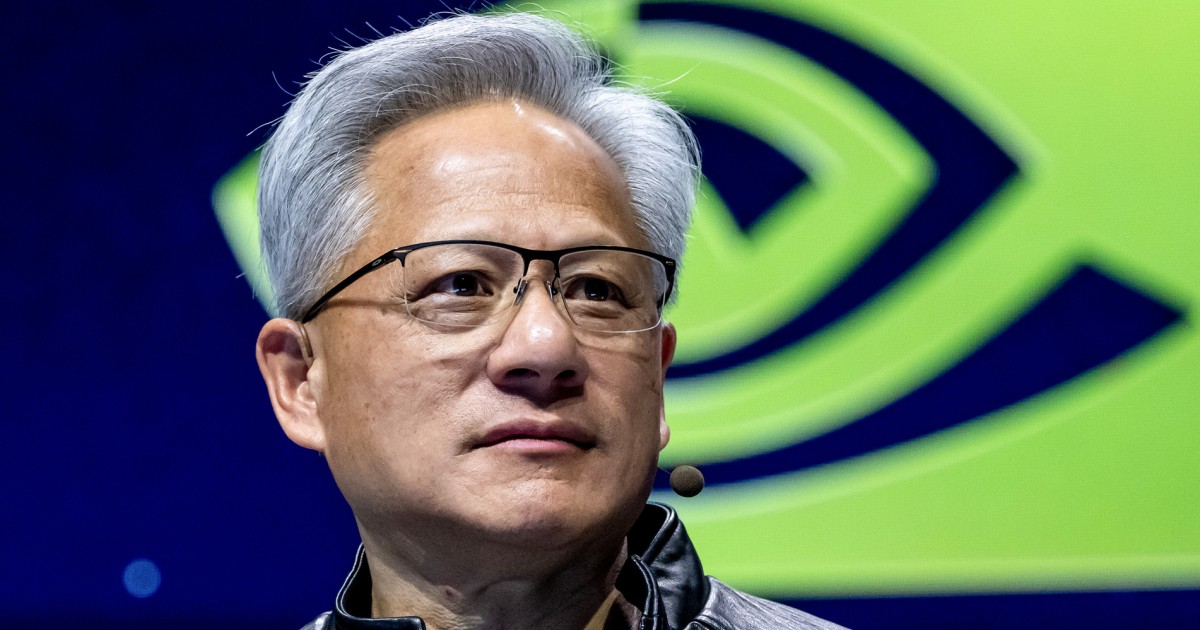
Jensen Huang resigns, Colette Kress is interim CEO
NVIDIA's board accepted Jensen Huang's resignation as president, CEO, and director, and named longtime CFO Colette Kress interim CEO while it searches for a permanent successor.
What they showed / shipped
- In an official NVIDIA newsroom post dated November 12, the board said Jensen Huang has resigned as president, chief executive, and a member of the board, effective immediately. Longtime CFO and executive vice president Colette Kress will serve as interim CEO and keep the CFO role until a permanent successor is named. The board will consider internal and external candidates. Harvey C. Jones, a director since 1993, was appointed the company's first-ever chair of the board. A matching SEC filing says the board accepted the resignation on November 11.
- Jones said the board expects operations, customer commitments, and the product roadmap to continue without interruption. Kress said the company will keep building on the foundation Huang created over 33 years. Perplexity CEO Aravind Srinivas posted a tribute to Huang's leadership Aravind Srinivas on X.
- The resignation follows days of reporting about Huang's personal life and related investigations, which this brief had already parked rather than lead with. The new, checkable artifact today is the official transition: Kress as interim CEO, Jones as the first board chair, and a formal search for a permanent CEO.
Why it matters
- This is the leadership change at the company that supplies most of the industry's training chips. The useful facts are who is running NVIDIA tomorrow morning, and that the board is saying the roadmap continues.
- Do not make the scandal the segment. If you mention it, keep it as the reason the board acted, then go back to the succession and the chip-supply questions from the fingerprint and tracking stories above.
Sources
 x/@GoogleDeepMind
X@GoogleDeepMind
♥ 7.4K↻ 620👁 1.5M
x/@demishassabis X@demishassabis
♥ 3.8K↻ 240👁 140K hn/Gemini 4 Hydrogen
blog.google
 hn/Gemini 4 Hydrogen and Orchestrator
antigravity.google
 hn/Gemini 4 Hydrogen
@thisisauserid
♥ 20
 x/@arstechnica.com
arstechnica.com
 x/@theverge.com
theverge.com