01
Gemini 4 Argon ships to everyone
Google finally released Gemini 4 Argon globally, claiming it beats GPT-6 Astra, Fable 5.1 and Opus 5.5 across coding, cyber, science, finance and law, and early testers are already building whole apps and decks from one prompt.
What they showed / shipped
- Live today across the API, Gemini app, Search, Antigravity and Enterprise; app access is Pro and Ultra only (x/@GoogleDeepMind, Ars).
- Reported specs: 1M context, $2 / $10 intro pricing per million tokens, #1 on the Vals Index (x/@minchoi).
- Google also claims less hedging, repetition and cliches, the stuff that makes chatbot prose read like a chatbot (The Verge).
- Early-access demos: an interactive Apple computer museum with scraped archival photos and 50 years of specs (x/@venturetwins), a new level hacked into a 36-year-old SNES game in raw assembly (x/@venturetwins), and a power-bottleneck deck built from 8 years of 10-K and FERC queue data (x/@venturetwins).
- Hassabis showed a 3D wizard chess game built with it (x/@demishassabis); r/singularity has it building a full Blender temple complex with self-critiquing agents (r/singularity).
Why it matters
- $2 / $10 undercuts Meta's new Muse Wonder ($4 / $20) by half, with 1M context. That is the A/B to run this week for long-document and agent jobs.
Sources
02
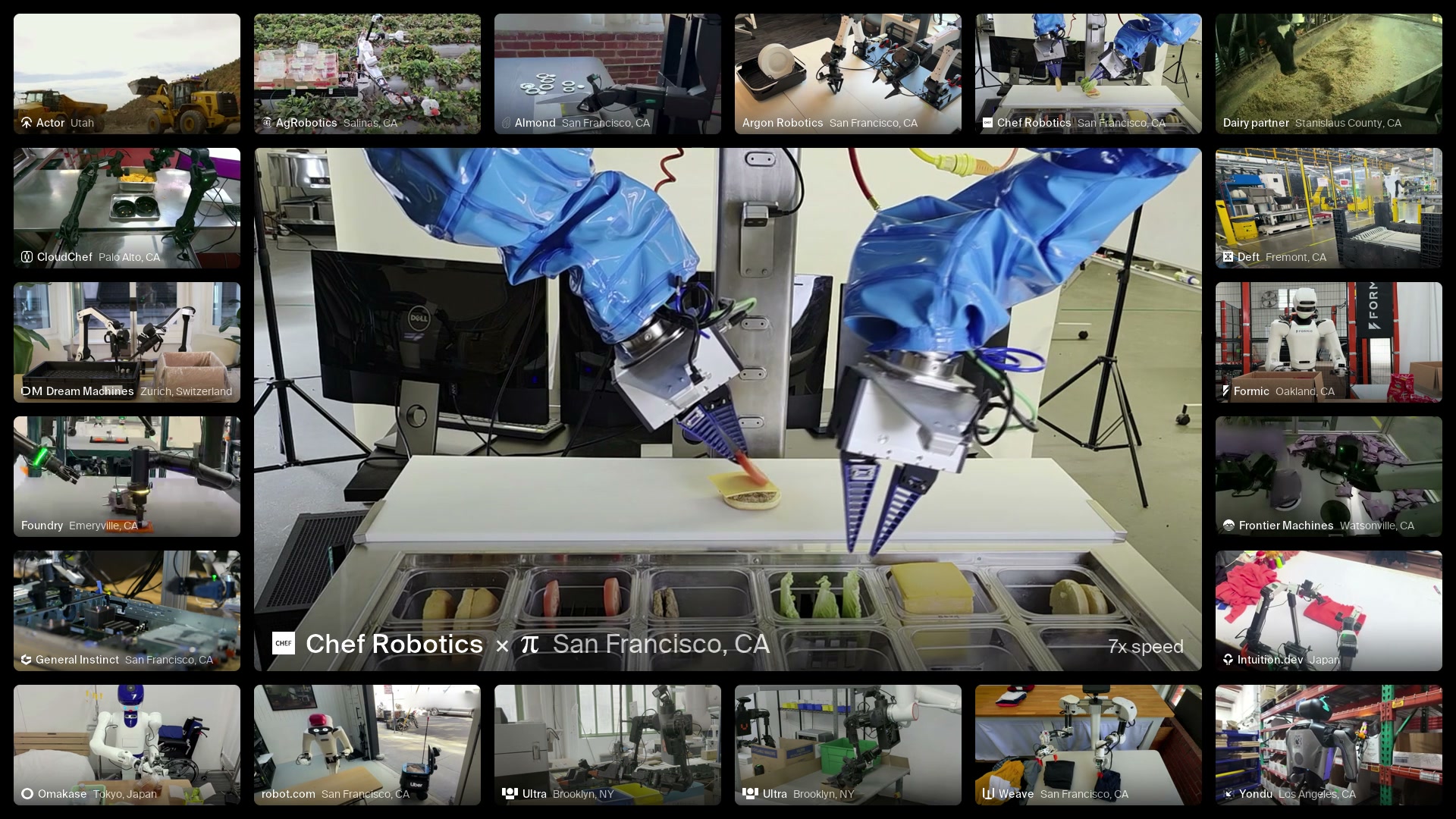
Robots learn from one video, and Pi opens an API
Gemini 4 Argon taught Apptronik's Apollo humanoid cornhole from a single human video by writing its own physics sim, and Physical Intelligence opened an API so anyone can fine-tune its robot foundation models.
What they showed / shipped
- Argon watched one video, mapped the physics, coded a simulation, and Apollo sank 7 throws in a row; Google says it cuts weeks of robotics work to hours (x/@GoogleDeepMind).
- Argon scores 87% on the ERQA embodied-reasoning benchmark with pure reasoning, and built a MuJoCo digital twin of a pedal trash bin before Spot stepped on the real one (Google Developers).
- Pi API beta: upload robot data, fine-tune on Pi-managed compute, and serve the model from a hosted gateway, no ML infra needed (Physical Intelligence).
- Same day at Disrupt: Industrial Next pitches factory robots that switch tasks in minutes, and Laplace red-teams robots and self-driving cars before deployment (TechCrunch).
Why it matters
- Robot training is turning into an API call. Data in, fine-tuned policy out, which is how LLM fine-tuning felt in 2023.
Sources
03
Dead startups are selling their data to AI labs
Shutdown brokers now sell dying startups' code, Slack, Notion and email archives to AI labs, and 47% of SimpleClosure's deals include a code or data sale; Character.AI's own wind-down sold assets to Disney for $20M.
What they showed / shipped
- SimpleClosure's Asset Hub has done 150+ deals and expects to return over $10M to startups by end of 2026; one crypto founder netted about $25K for code plus roughly $15K pending for workspace data (MIT Tech Review).
- Buyers are foundation labs, simulated-workspace vendors and big companies training their own models; rival Sunset prices assets by head count, years and data volume (same source).
- Character.AI filed voluntary Chapter 11 for a court-supervised sale, with Disney offering $20M for some of its chatbot tech (Character.AI, Ars).
Why it matters
- Real company workflow data (tickets, chats, docs) is what agent training needs, and the market now has a price on it.
Sources
04
Anthropic outgrew git at 30,000 merges a day
Anthropic went from about 2,500 merged code changes a day in May to over 30,000 in September, so it built its own version control system, Scion, and moved its monorepo off git in five months.
What they showed / shipped
- 12x growth in merges in four months; Anthropic says coding is no longer the bottleneck, human-scale infra (source control, builds, CI) is (x/@AnthropicAI).
- Also built a code review surface (Antique), code search and source-control IAM in the same window (Anthropic Engineering).
- Circulating summary: 7 engineers, 200x less infrastructure, 100x faster checkouts (x/@minchoi).
Why it matters
- When agents write the code, the next wall is review, CI and merge throughput. Plan for that before you hit it.
Sources
05
Try today: private Android apps, Runway in Replit, $8 Grok bundle
A cluster of build-it-yourself doors opened yesterday: private vibe-coded Android apps on Google Play, Runway assets inside Replit, and a cheap Grok plus Cursor plus X Premium bundle.
What they showed / shipped
- Google Play now lets you vibe-code an app in AI Studio and install it privately on your own phone, no public listing; US, 18+ to start (TechCrunch).
- Runway for web design: connect Runway to Replit and generate images, video and site assets inside the project (x/@runwayml).
- Grok, Cursor and X Premium bundled from $8/month, with $30/month adding Grok Bot, as reported (x/@minchoi).
- Shopify will let shoppers point their own AI agents at its billion-plus listing catalog to buy for them (The Verge).
- Small ones: PDF to audiobook using your OpenAI subscription (pdftomp3), and Pulse Local, a Mac budgeting app with on-device models (Pulse).
Why it matters
- Personal Android apps without store review removes the main reason people kept vibe-coded tools on the web.
Sources
06
Xbox makes AI game ports official
Microsoft formed Xbox Labs to embrace the wave of AI-assisted decompiles and recompiles that are porting old games to Macs, browsers and new hardware, even when it challenges its own business model.
What they showed / shipped
- Xbox CEO Asha Sharma: a small team of game makers, engineers and scientists that will 'build in the open' and share tools with developers (The Verge).
- Her framing: coding became agents' first workload because code can be written, run and tested, games share those properties, and people play 72B+ hours of Xbox a year, about 5x the time spent writing code (same source).
- Prompted by recent mods like Halo in a browser and skateboarding modded into Call of Duty; Microsoft did not comment on unauthorized IP (same source).
Why it matters
- Games as the next agent workload is a real thesis; harness write-ups like this one show the patterns (Kyle Kukshtel).
Sources
07
Run models on hardware you already own
Three signs that inference is escaping the datacenter: Qwen 27B on a jailbroken PS5, Apple's paper on pooling idle Macs into a GPU cloud, and four 9-year-old V100s beating new desktop AI boxes.
What they showed / shipped
- Someone is running Qwen 27B at about 20 tok/s on a jailbroken PS5's GPU (r/LocalLLaMA).
- Apple's Minions paper aggregates idle Apple Silicon GPUs across Macs into a fault-tolerant inference cloud, no new GPU purchases (Apple ML Research).
- Four Tesla V100s on an NVLink board beat M5 Ultra and DGX Spark in some AI benchmarks by up to 230%, as reported (r/LocalLLaMA).
Why it matters
- The office full of idle Macs is now a legitimate inference cluster, and Apple is publishing the recipe.
Sources
08
Claude's oboe concerto passed for human 60% of the time
A listener test reportedly had 60% of people judge a Claude Opus 5.5 oboe concerto as human-composed, above real Handel (58%) and Vivaldi (43%), the same day a Harvard physicist reported 36 manuscripts in three months with Claude.
What they showed / shipped
- Opus 5.5 concerto rated human by 60% of listeners vs 58% for Handel and 43% for Vivaldi, as posted (r/singularity).
- A Harvard physicist produced 36 manuscripts across 18 fields in three months with Claude, as posted (r/singularity).
- Counterweight: scientists are asking whether AI tools are absorbing their unpublished ideas (Scientific American).
Why it matters
- Output volume is no longer the constraint for research or composition. Review and taste are.
Sources
09
Skeptic corner: hidden capabilities and OpenAI's FFT claim
A new paper argues AI models can provably hide arbitrary capabilities from evaluators, and a close read of OpenAI's faster-Fourier-transform claim checks what the math actually shows.
What they showed / shipped
- 'AI Models Can Provably Hide Arbitrary Capabilities' by Andis Draguns and 3 coauthors, submitted Oct 9 (arXiv).
- The argmin blog's breakdown of the math behind OpenAI's faster FFT claim (argmin).
- Anthropic's anti-distillation measures may have cut data harvesting by 90 to 99%, per a community read (r/singularity).
Why it matters
- If capabilities can be hidden provably, benchmark-only evals are not proof of what a model can do.
Sources
 x/@GoogleDeepMind
X@GoogleDeepMind
♥ 6.4K↻ 663👁 2.5M
 x/@demishassabis
X@demishassabis
♥ 5.1K↻ 515👁 456K
 x/@venturetwins
X@venturetwins
♥ 1.4K↻ 122👁 52K
 x/@venturetwins
X@venturetwins
♥ 988↻ 68👁 68K
 x/@venturetwins
X@venturetwins
♥ 208↻ 11👁 13K
 x/@minchoi
X@minchoi
♥ 82↻ 9👁 12K
 x/@theverge.com
theverge.com
 x/@arstechnica.com
arstechnica.com