01
Memory that works: Claude dreaming + Stanford Memorilla
Two memory systems landed the same day: Claude now reorganizes its notes offline, and Stanford packs a whole document store into 16 tokens.
What they showed / shipped
- Anthropic published The components of agent memory, showing how dreaming lets Claude correct bad notes, build searchable wikis, and preload what the next session needs (@AnthropicAI, blog).
- Hard number from the post: dreaming a wiki over a ~420M-token internal corpus raised scores on 25 questions from 13% after 2 sessions to 48% after 128.
- Stanford's Memorilla recalls a whole document collection as 16 query-dependent memory tokens for a frozen LLM: up to 4,212× fewer document tokens, 27× faster on a 512-document test, best average vs Mem0 and MemoRAG (r/singularity, site, arxiv).
Why it matters
- Dreaming is the offline half of agent memory (fix notes against transcripts), and Memorilla is a concrete alternative to stuffing RAG chunks into context.
Sources
02
DeepMind agents find cracks in legacy RSA
Human-guided DeepMind agents uncovered two weaknesses in old 1024-bit RSA, a concrete example of AI speeding up cryptanalysis.
What they showed / shipped
- Google DeepMind says AI agents, guided by humans, found two major weaknesses in legacy 1024-bit RSA: a signature-forgery path and a cheaper batch-factoring algorithm for related moduli (@GoogleDeepMind).
- Caveat they lead with: modern 2048-bit and larger RSA is not claimed broken by these findings.
- Secondary reports put one attack improvement around 1,600× faster for a narrow 1024-bit case; treat that multiplier as press until you read the primary writeup.
Why it matters
- The teachable point is tempo. Agents compress years of exploratory math into a steered research loop.
Sources
03
BioBasicsBench: can agents read a wet-lab gel?
OpenAI shipped a 100-task wet-lab benchmark with Ligo, and Anthropic posted how AI is starting to write and revise scientific models as code.
What they showed / shipped
- OpenAI and Ligo launched BioBasicsBench: 100 routine wet-lab tasks from raw gels, colony plates, microscopy, and instrument readouts. At xhigh, GPT-6 Astra scored 66.7% mean reward vs 43.8% for GPT-5.6 Sol (@OpenAI, post).
- Anthropic's science blog covers AI writing, fitting, and revising scientific models as code so researchers can explore competing explanations faster (@AnthropicAI).
- 📌 On the radar: Anthropic also posted How researchers use Claude for scientific discovery (HN).
Why it matters
- BioBasicsBench tests the boring, high-stakes part of science agents: reading messy evidence and knowing when not to conclude.
Sources
04
A 32MB speech model that runs in your browser
Underdog's Woof is a ~32MB text-to-speech model that speaks offline in a browser demo, open weights included.
What they showed / shipped
- Underdog demoed Woof: a 31.7MB / ~31M-parameter TTS model that runs locally via WebGPU, wrapped in a retro browser game where you type and it speaks (TechCrunch).
- Weights are open to download. Weeks earlier they shipped Bark, a 167MB on-device speech-to-text model.
- Founder angle: build private, on-device voice instead of cloud notetakers.
Why it matters
- A speech model this small changes where voice can live: pages, apps, offline tools.
Sources
05
Closed models took back the price-performance frontier
Village's Atlas says open-weight models are the best buy at only 3% of budgets now, down from 41% in June.
What they showed / shipped
- Village reports open-weight models win at 3% of price points on its LLM Atlas, down from 41% in June. Nearly all remaining open wins are at the cheap end via Gemma 4 E4B and MiMo-V2.6-Flash (Village, HN).
- They credit GPT-6 Luna, GPT-6.1 Terra, and Claude Haiku 5.5 for clawing back the mid-budget band DeepSeek used to own.
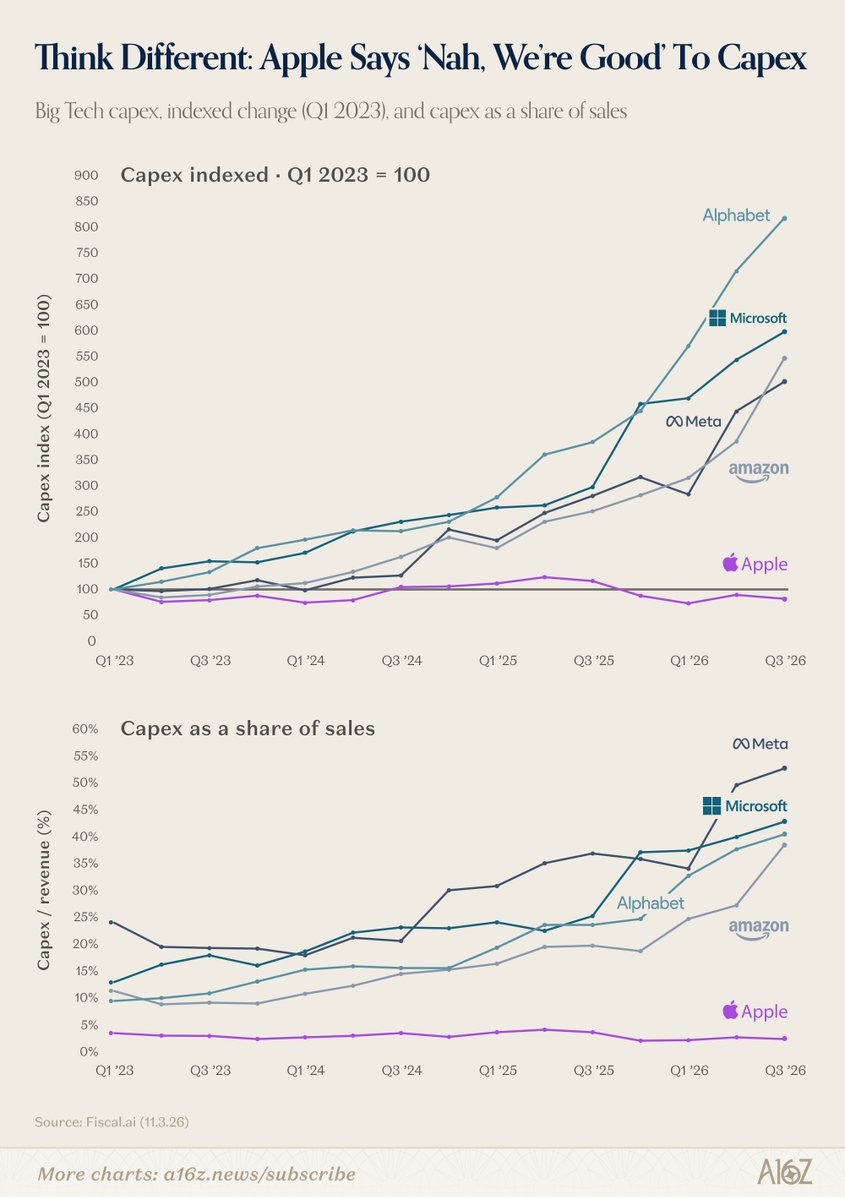
- 📊 Chart flag: a16z Charts of the Week show Alphabet/Microsoft/Amazon/Meta CapEx up 5-8× since Q1 2023, while Apple spends 20% less than before the AI boom (@a16z).
Why it matters
- If you pick models by API price vs quality, closed mid-tiers currently own most budgets. Self-host still changes the math.
Sources
06
GPT Image 2.6 is live in Runway
Runway added GPT Image 2.6 with faster gens, GIFs, SVG export, and tighter character edits.
What they showed / shipped
- Runway says GPT Image 2.6 is available: about 50% faster image generation, GIF support, SVG vector export, and precise edits that keep characters and products consistent (@runwayml).
- 📌 On the radar: Google's Gemini Omni 1.2 Flash is now GA on the Gemini API with native 15s video and 30% lower price. Yesterday's brief already covered it inside Runway (Google).
- 📌 On the radar: Meta Muse Spaces lets you spin custom collaboration spaces with your Muse agent (TechCrunch).
Why it matters
- SVG + GIF from an image model shortens the path from prompt to shippable asset.
Sources
07
Embodied weekend: a humanoid cleans, Claude paints
MIT Tech Review watched a humanoid clean an apartment, and Claude drove a robot arm to paint a watercolor while mixing its own colors.
What they showed / shipped
- MIT Technology Review's first-person piece: a humanoid robot cleaned an apartment and felt like a taste of near-term home robotics (MIT TR).
- Claude painted a watercolor tree with a robotic arm in 4.5 hours and mixed custom colors along the way (r/singularity).
- 📌 On the radar: Physicl raised $10M to make digital worlds real enough for robot training (TechCrunch).
Why it matters
- Household chores and art arms are the demos that make embodied AI feel concrete.
Sources
08
Try local: a tiny embedding killer and Arete-27B
LocalLLaMA's weekend shelf: a 0.1B embedding model that beats much larger ones in a user test, plus Nous Arete-27B.
What they showed / shipped
- A LocalLLaMA post claims a 0.1B embedding model beat 8B embedding models in their try-out (thread).
- NousResearch Arete-27B (Qwen finetune) hit Hugging Face (thread).
- 📌 On the radar: XingChen Xing4.0 29B-A4B GGUF via bartowski, and community notes that some GPU prices are dropping (Xing GGUF, GPU prices).
Why it matters
- Tiny embeddings change RAG cost on a laptop. Verify the claim on your own corpus before swapping.
Sources