01
A 14B video+audio model that runs in 6 steps
Video Rebirth compressed MiniMax-H3 from about 31B parameters down to 13.7B, so a 5-second clip can run in about a minute and a half on a 5090.
What they showed / shipped
- On HN, Video Rebirth engineer Jian posted HyperFlow H3 Flash: they pruned 3 of 50 blocks and factored 102 linear layers to cut MiniMax-H3 from about 31B parameters to 13.7B, added two-time conditioning so it samples in 4 to 8 steps without CFG, and applied W8A8 INT8 on 180 layers (HN, GitHub).
- Hard numbers for a 5.2 second clip at 1344x768, 6 steps: 8.7 seconds on 4x B200, 36 seconds on one H200, 92 seconds on an RTX 5090, and 266 seconds on an RTX 3090. The Q4_K_M GGUF is 9.1 GB and they say it runs in ComfyUI on 24 GB cards.
- The product page calls this real-time 768p on four B200s (HyperFlow H3 Flash). Jian's caveat: their package takes 8.7 seconds to make a 5.2 second clip on 4x B200. Playback-speed generation uses NVIDIA's SOL-H3 runtime.
- License caveat: code is Apache-2.0, but the weights derive from MiniMax-H3's Community License, which does not cover the US, EU, UK, or South Korea without MiniMax's authorization.
Why it matters
- A joint video+audio diffusion model that fits on a 24 GB card is something you can actually try, not just watch a lab demo.
Sources
02
Lattice is Cursor for research papers
Leonardo open-sourced a local Mac app that keeps your LaTeX, citations, Overleaf co-authors, slides and your own coding agent in one window.
What they showed / shipped
- Lattice is a free, local-first LaTeX workspace for Apple Silicon Macs. It combines live PDF preview, paper import by arXiv ID or DOI, one-click citations, markdown notes, slides, and two-way Overleaf sync, then drives the coding agent you already use: Claude Code, Codex, Cursor, OpenCode, or Droid (@minchoi, site).
- There is no bundled model or Lattice subscription. Your project stays a normal folder on disk, so it works with Git. It needs macOS 14+ and a TeX install. The app is Apache-2.0, with a note that the Trellis panel layout is free only for non-commercial use.
- 📌 On the radar: Perplexity's Arav says Teammate automation runs grew 3.7x from launch day to day two, and people are using it as a chief of staff for calendar, email, vendors and briefs. It can also watch market orders (@AravSrinivas, CoS post).
Why it matters
- This is the research equivalent of an agentic IDE, without locking you into one lab's model.
Sources
03
Chip stocks fell as far as they did in Covid
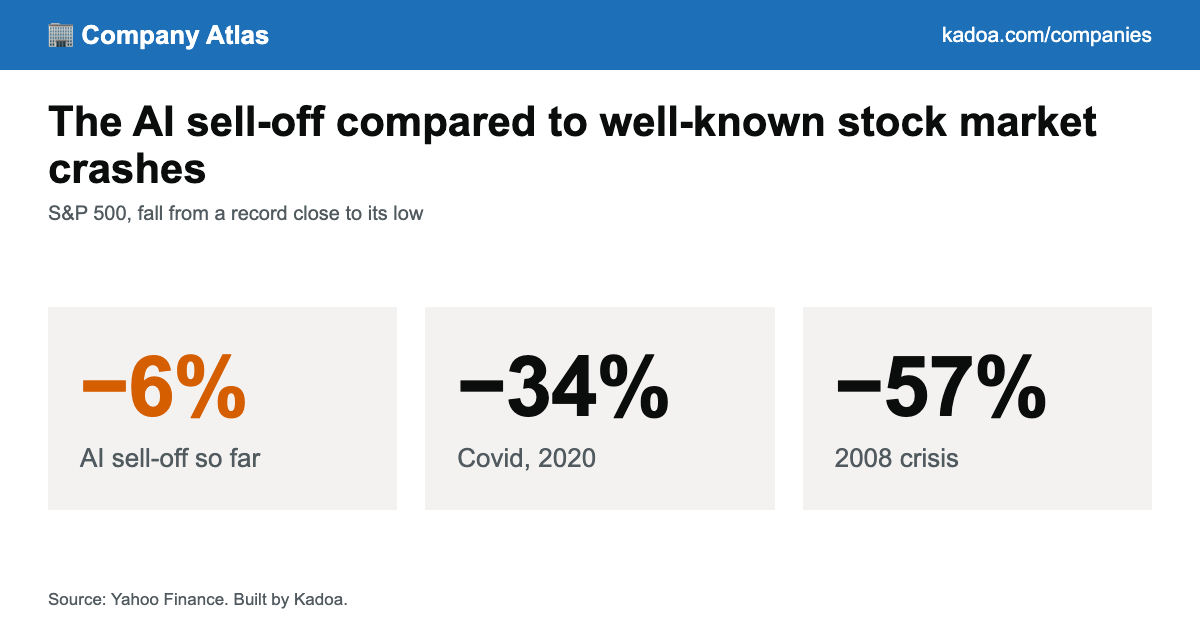
A chart of the AI sell-off shows the S&P is only about 6% off its record, while US chip stocks are down 36%, matching their Covid drop, and AMD's CEO just said the company is data center first.
What they showed / shipped
- 📊 Kadoa compared the slide since the October 6, 2026 record with past crashes. As of the November 6 close, the S&P 500 was about 6% below its record (the table lists -5.7% after 23 trading days). The Nasdaq was about 11% down. US chip stocks, the PHLX Semiconductor index, were 36% below their June 22 record, as deep as their Covid fall of 35% (Kadoa).
- Thursday, November 5 was a -4.4% day for the S&P, the worst since April 4, 2025. Kadoa notes that four in five S&P drops of 6% from a record never reached -20%.
- The same weekend, AMD CEO Lisa Su told Yahoo Finance, "We are a data center first company; that is our profile." PCMag reports AMD's Q3 revenue hit a record $13.4 billion, almost double last year, and 63% came from data centers. Consumer cards are following that shift: the RX 9070 XT is over $900, about $300 above its launch price, and even 8 GB cards are over $500 (PCMag, r/LocalLLaMA).
Why it matters
- The teachable split is index vs chips. A mild S&P dip can hide a Covid-sized hit to the GPUs you actually buy.
Sources
04
A supermarket robot in Zurich, and Figure's HQ fills with humanoids
A Reddit post says Theseus Robotics' wheeled humanoid Theo is restocking a Zurich supermarket at night, while new videos show dozens of Figure 03s walking the company's campus.
What they showed / shipped
- A r/singularity post says Theo, a wheeled humanoid from Zurich startup Theseus Robotics, now works at a supermarket there. The claim: it can restock 400 items an hour at night in the dark, and handle online orders and other tasks by day (r/singularity).
- Theseus (YC Fall 2026) describes itself as automating the last 30 metres of retail with shelf restocking, stock rotation and order picking (theseus.bot). The company site does not publish that 400-an-hour figure or name the store, so treat the rate as the Reddit claim until Theseus confirms it.
- The same window, Humanoids Daily reported new Friday and Saturday videos from Figure founder Brett Adcock showing dozens of Figure 03 robots walking the lawn, lobby and paths at HQ. Figure has said little about how many of those units do paid customer work (r/singularity, Humanoids Daily).
Why it matters
- Overnight grocery restocking is a concrete job, not a lab demo, even if the speed claim still needs a first-party source.
Sources
05
Don't Ask Again left secrets in 1,122 GitHub files
Apiiro found that Claude Code can save the exact shell command you approved, password included, and 1,122 public copies of that settings file on GitHub hold at least one secret.
What they showed / shipped
- When you pick "Yes, and don't ask again," Claude Code can write the command word-for-word into
.claude/settings.local.json. If that command included a password or API key, the secret is saved in plain text (HN, Apiiro, The Hacker News).
- Apiiro searched public GitHub and found 104,185 copies of the file across 103,617 repositories. About 1.1%, or 1,122 copies, held at least one secret, totaling 1,379 distinct secrets. That includes 379 database passwords, 43 SSH logins, 42 GitHub/GitLab/npm tokens, and 23 AWS keys. One company they notified confirmed its key had been live. They did not test whether other secrets still work.
- Claude Code adds the file to your computer's global git excludes, not the project's
.gitignore, so the protection does not travel with the repo. In 539 of 1,105 traced leaking repositories, a commit listing Claude as co-author had changed the file. Advice: search your orgs and git history, rotate every secret the file ever held, then stop tracking it.
Why it matters
- This is a mechanism you can teach and a checklist you can run today, not a vague 'AI is sloppy' scare.
Sources
06
One county now gets 40% of its budget from data centers
Loudoun County, Virginia, home of Data Center Alley, says data centers brought in $1.2 billion in fiscal 2026, 39% of the whole county budget, with 40% projected next year.
What they showed / shipped
- Loudoun County's official explainer says that in fiscal year 2026, data centers generated $1.2 billion in real and personal property tax revenue, 39% of the county's overall budget. The FY 2027 adopted budget projects $1.3 billion, or 40% (Loudoun County, r/singularity).
- As of March 1, 2026 the county counted about 233 existing data center buildings and 56.5 million square feet built or under construction, plus about 35.7 million square feet approved but not yet built. It says more than 17,000 direct and indirect data-center-related jobs have been created.
- The same page notes the county is trying not to depend only on this revenue, after eliminating by-right data center zoning in 2025. A Reddit summary floated that this tax haul comes from about 3% of the land; that split is not in the county section I checked, so I am not treating the 3% figure as confirmed.
- 📌 On the radar: TechCrunch says the midterms left the data-center buildout looking rockier, including for Elon Musk, and Crusoe sold its troubled Wyoming data center project to Google (TechCrunch midterms, Crusoe).
Why it matters
- This is the cleanest number yet for how concentrated the AI buildout's tax base has become in one place.
Sources
07
Brave sold its search index to AI labs, and you cannot block its crawler by name
The New York Times sued Brave for copying more than 30 billion pages and selling that index to AI companies, and Brave's crawler has no distinct name you can put in robots.txt.
What they showed / shipped
- Search Engine Journal walks through the November 2 New York Times lawsuit: the Times says Brave copied more than 30 billion webpages without a way for site owners to block its crawler, then sold that index to AI companies (SEJ, HN).
- Brave's own About page says its Search API is used by Cohere, Mistral, Perplexity, and You.com, and that the index holds over 30 billion pages. The Times complaint also names Anthropic and xAI as customers. Those companies are not being sued. Brave had not answered the suit when the article ran, so the copying-without-notice piece is still a claim.
- The mechanism: Brave says its crawler "does not advertise a differentiated user agent," so it follows Googlebot rules instead. You cannot allow Google and block Brave by name in robots.txt. The practical check is
site:yourdomain on search.brave.com.
Why it matters
- If you carefully block GPTBot and still show up in an index sold to AI labs, this is why.
Sources