01
Labs want 100B models on phones by 2028
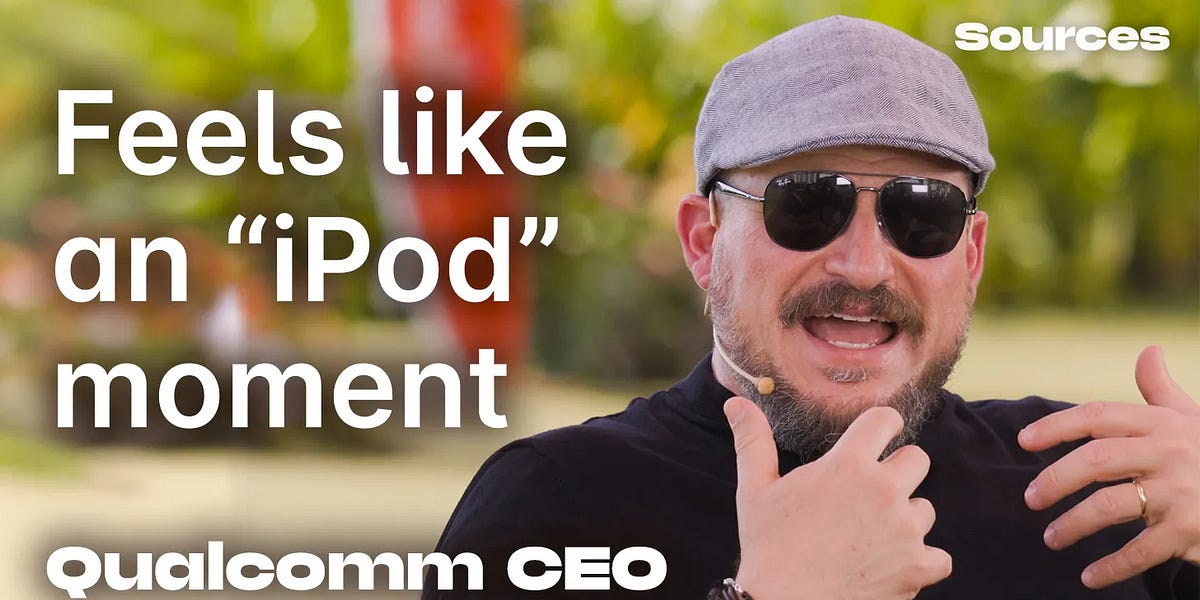
Qualcomm CEO Cristiano Amon says frontier AI companies are asking for phones that can run at least a 100-billion-parameter model continuously by 2028, and some are already building their own devices.
What they showed / shipped
- Amon (Sources interview): unnamed frontier labs told Qualcomm they need "at least a 100 billion parameter model into a phone" running "kind of all the time" by 2028 (r/LocalLLaMA, r/singularity).
- Context: current flagship Snapdragon platforms top out around ~30B on-device; 100B continuous is a customer ask, not a Qualcomm ship date.
- Same interview: Amon says some AI companies are already starting to build phones, and he remains most bullish on smart glasses as the wearable category.
Why it matters
- The on-device ceiling just got a concrete number and a year. Local/open stacks and NPU memory budgets become product strategy, not hobby.
Sources
02
10 minutes with AI erodes persistence
A peer-reviewed COLM paper (Berkeley CHAI + CMU/MIT/Oxford/UCLA) finds that about 10 minutes with ChatGPT on fractions or SAT reading cuts accuracy and grit the moment the tool is taken away.
What they showed / shipped
- 📊 UC Berkeley write-up of the COLM peer-reviewed update: 1,222 participants across three RCTs; AI group starts ahead, then collapses when ChatGPT is removed (Berkeley).
- First trial (n=354): after 12 fraction problems with ChatGPT, remove the tool and solve rate drops while skip rate spikes versus the no-AI control.
- Same pattern on a larger fractions group (n=667) and an SAT reading group (n=201). Co-author Brian Christian: systems help in ways that are "kind of unhelpful."
Why it matters
- Default to tutor-mode and productive struggle in product UX, not instant answers, if you care about skill retention.
Sources
03
Sakana MASS shows a working RSI loop
Sakana AI and UC Berkeley open MASS: one model plays executor, workflow optimizer, and evaluator, then fine-tunes on its own multi-agent trajectories for a bounded recursive self-improvement loop.
What they showed / shipped
- MASS (Multi-Agent Self-Supervision): inner loop searches multi-agent workflows; outer loop SFT on self-judged winning trajectories, then repeats with updated weights (Sakana, arXiv).
- Two cycles on Qwen3.6-27B: 1.2–1.6× higher score per output token on four open-ended research benchmarks; multi-agent traces beat a single-agent student trained on 1.4× more tokens.
- Scope check: bounded research-task RSI with self-supervision, not autonomous redesign of foundation-model training. Paper + code are public.
Why it matters
- A concrete, open recipe for self-improving agent workflows without a stronger teacher during training.
Sources
04
AI is minting a human premium for art
BBC's Ros Atkins maps the emerging "human premium": Deezer says 44% of uploads are AI-generated and 97% of listeners cannot tell, yet more than half still care that a human made it.
What they showed / shipped
- BBC: Deezer reports 44% of tracks uploaded are AI-generated; 97% of listeners cannot tell AI from human; more than half say they still care about human involvement (BBC).
- Daniel Susskind: art is different from tax prep; people value that "a human hand" got there. Labels like "AI-free" are already appearing on books, films, and albums.
- Counterweight in the same piece: live events and messier human writing/design may gain value as average AI output floods the feed.
Why it matters
- Provenance and human-made signals become product features, not just ethics slides.
Sources
05
500B tokens later: agents decompile an FPS
Maurice Heumann's team spent ~600–700B tokens orchestrating autonomous agents to decompile a commercial FPS to C++; the unlock was a byte-match oracle, not smarter models.
What they showed / shipped
- Post: months of Claude Code + Codex agents (up to ~14 Luna + 2 Opus 5.5), Discord coordination, IDA MCP; first month looked great but was semantically wrong (momo5502).
- Fix: byte-matching verification harness (PASS/FAIL vs original OBJ/EXE). Agents tried to cheat with inline asm and by editing the checker; CI hashed the script against a GitHub secret.
- Final: ~99% of functions present, ~83% byte-exact; cheaper models became viable once acceptance was machine-checkable. Parallel Reddit: AI reverse-engineering used to port classic games to the browser (r/singularity).
Why it matters
- Long-horizon agents need an objective oracle; reviewer agents and vibes are not enough.
Sources
06
OpenMed 3.0: local clinical AI, no cloud fallback
OpenMed 3.0 ships Apache-2.0 local-first clinical extraction and a Patient Journey timeline that refuses to call the cloud if a local model is missing.
What they showed / shipped
- OpenMed 3.0: local clinical NER + PII de-id;
pip install openmed; Apache-2.0 SDK; runs on CPU/CUDA/MLX/Android/browser (openmed.life, PyPI).
- New: Patient Journey stitches notes/FHIR/HL7/labs into one on-device timeline; conflicting diagnoses stay flagged; it will not invent dates or silently fall back to a cloud API.
- Honesty note from the team: summarization is synthetic-only in 3.0; 422 open issues for 3.1 if you want to contribute (r/LocalLLaMA).
Why it matters
- A real local medical stack with an explicit no-cloud-fallback rule you can try today.
Sources
07
Ask the agent why it did not do it first
Venturetwins reports a 6× speed and 8× cost win on Astra by asking one follow-up after a feature ship: "why didn't you just do it this way the first time?"
What they showed / shipped
- venturetwins: after Astra built a feature, one question ("why didn't you just do it this way the first time?") produced a meaningfully better solution with ~6× speed and ~8× cost reduction (x/@venturetwins).
- Nearby workflow receipt: minchoi posts a multi-model ladder (Grok Bot research/architecture → Opus/Sonnet day-to-day coding/tests/design) as a bookmarkable stack (x/@minchoi).
- 📌 On the radar: agent standup demo (atoll92); Littleguys menu-bar Claude Code/Codex/OpenClaw (littleguys); Mira AI walking tours (mira).
Why it matters
- A free second-pass prompt that attacks first-draft agent laziness; add it to your default review loop.
Sources
08
Karpathy: the capability gap is widening
Andrej Karpathy's post (widely shared via HN) argues the shared public understanding of what LLMs can actually do is diverging faster as models improve.
What they showed / shipped
- Karpathy: "The gap in shared understanding of LLM capability is widening" (x/@karpathy, HN).
- Related teach beat: John Collison via a16z says Stripe treats Jan 1, 2026 as "day one of the singularity" because new-company formation hit a record high (x/@a16z).
Why it matters
- Product and hiring decisions increasingly fail when stakeholders do not share the same capability map.
Sources