01
Stripe's data says the solopreneur era is here
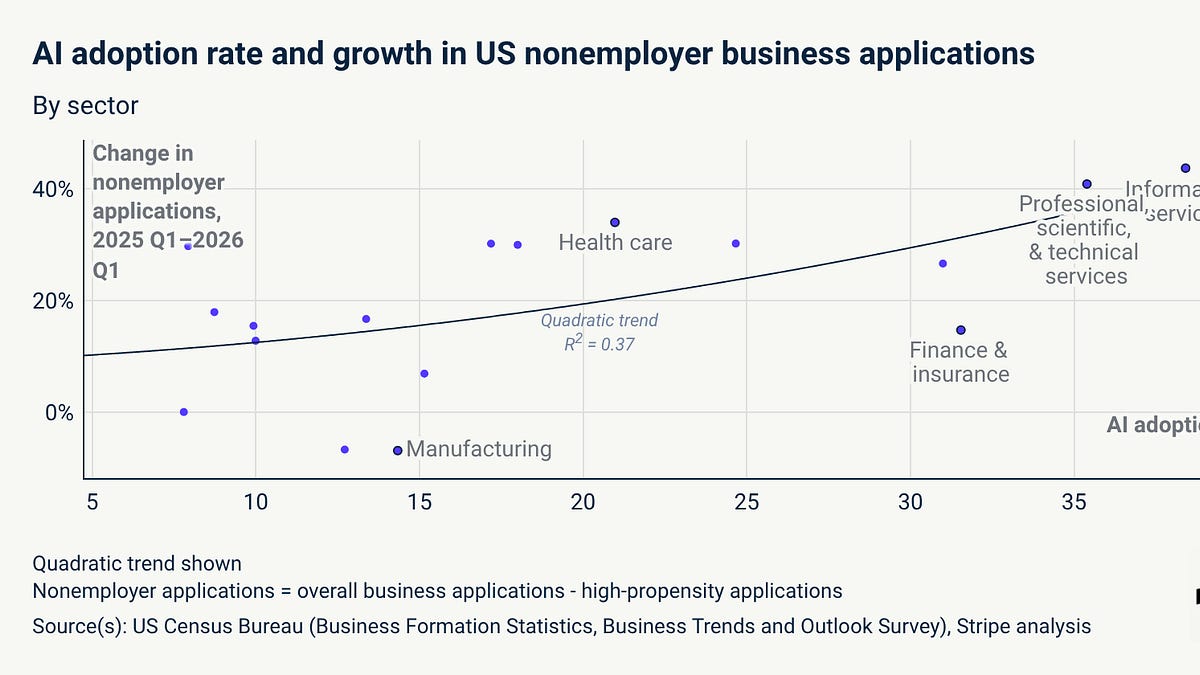
Stripe Economics dropped "The Age of the Solopreneur" - hard payment data showing one-person businesses are scaling to millions, fast, and AI is a measurable part of why. This is the trend TechGuyver is built on, with real numbers behind it.
What they showed / shipped
Why it matters
- The data says the leverage is real, not vibes - AI-assisted starts up sharply, top performers reaching revenue thresholds faster than any prior cohort.
Sources
02
The new way to train agents: drop them in a video-game world
Two big funding rounds landed on the same thesis: the way to teach AI agents real-world skills is to train them inside game-like simulated worlds. Patronus raised $50M to build worlds that stress-test agents; General Intuition raised $2.3B betting games can train agents for reality.
What they showed / shipped
Why it matters
- This is a door - simulated worlds become the gym agents train in, the way self-driving used sim. If you build agents, this is where reliability will come from.
Sources
03
IBM cracks the sub-1-nanometer chip
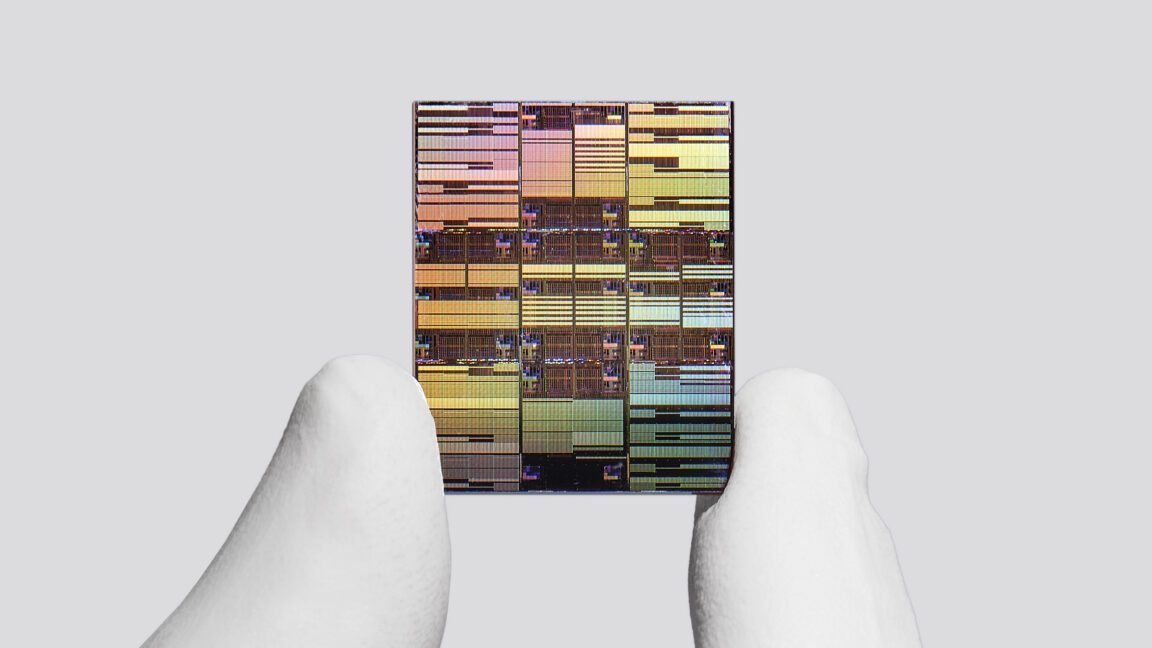
IBM showed the world's first sub-1nm chip tech: 0.7nm / 7-angstrom transistors stacked vertically, ~100 billion transistors on a fingernail-sized chip - almost 2x the density of its 2nm part.
What they showed / shipped
- IBM debuted 0.7nm / 7-angstrom "nanostack" transistors that stack and stagger vertically - ~100B transistors on a fingernail, ~2x the density of its 2021 2nm chip, with up to 50% more performance or 70% less power.
- It's a research milestone, not a product yet - the official IBM newsroom post frames it as the path past today's process limits.
Why it matters
- The entire AI cost curve bends on transistor density - more compute per watt is what makes on-device models and cheaper inference real.
Sources
04
OpenAI says agents are now doing the work, in every department
OpenAI published its own internal data: across every department, people are handing real, long-running, cross-functional work to Codex - the shift from chatting with AI to delegating to it, measured inside the lab that builds it.
What they showed / shipped
Why it matters
- This is the playbook leak - the company shipping the agents is telling you exactly how delegation replaces chat. Watch which task types they hand off first.
Sources
05
Adobe buys Topaz as the creator-AI stack consolidates
A big day for the creator toolchain: Adobe acquired image/video enhancer Topaz Labs, Runway shipped an autonomous "Agent 2.0" for full marketing campaigns, and Midjourney pushed a V8.2 preview - the tools creators actually touch all moved at once.
What they showed / shipped
- Adobe acquired Topaz Labs, the maker of the upscaling/enhancement tools a lot of editors already run - folding best-in-class enhancement into the Adobe stack.
- Runway launched Agent 2.0: go from a prompt to full marketing briefs and campaign assets, then analyze performance and scale across formats and markets.
- Midjourney shipped a V8.2 preview (add
--preview) plus --sref random batch drafts that explore style space "24x faster."
Why it matters
- The enhancement layer is being acquired, not built - signal that the moat is moving from raw generation to the polish/agent layer on top.
Sources
06
A walking, flipping humanoid for the price of a gaming PC
Unitree's R1 humanoid crossed the gaming-PC price line: $4,900 for a robot that walks, runs, flips, and throws a spinning kick while catching its own balance - and the official launch video has 3.5M views. Embodied AI sliding from lab demo into consumer-price territory.
What they showed / shipped
Why it matters
- At $4,900 with ready stock the dev/hacker community gets real hardware - expect a wave of hobbyist robot content and mods, not just corporate demos.
Sources
07
The new moat is compute - and everyone's building their own chip
The clearest meta-trend in today's signal: compute is the moat now. Amazon has Trainium, Google has TPUs, Anthropic is exploring custom silicon, OpenAI has Jalapeño - and the bottleneck has moved to data-center build-out and power.
What they showed / shipped
Why it matters
- If every lab is racing to own its silicon, the cost and availability of compute is the variable that decides who ships - watch it like a stock ticker.
Sources
08
Claude is quietly winning paying customers
A market ChatGPT owns is shifting: Anthropic's Claude is winning over paid consumers - a real adoption signal under all the model-release noise, and a useful counter to the "it's all OpenAI" assumption.
What they showed / shipped
Why it matters
- If paying users are migrating, the tooling (Claude Code, Claude Design) is the wedge - worth a look if you've only tried the chat.
Sources
09
The US government is now gatekeeping who gets GPT-5.6
The GPT-5.6 release just got a new gatekeeper. After the model slipped, the US government reportedly asked OpenAI to stagger it - approving preview access customer by customer over security concerns. A real "the state is in the loop now" moment.
What they showed / shipped
Why it matters
- If access becomes a per-customer government approval, model availability becomes a policy question, not just a pricing one.
Sources
10
Apple's price hike doubles as an AI silicon pivot
Apple raised base Mac/iPad prices up to 25% on rising memory-chip costs (loaded 16" MacBook Pro now $9,999), and is reportedly skipping the M6 Pro/Max to fast-track an AI-focused M7 line - the memory crunch and the on-device-AI race showing up on the price tag.
What they showed / shipped
Why it matters
- An AI-focused M7 line means on-device inference is Apple's priority - good news if you build local-first, even as the hardware gets pricier.
Sources