01
OpenAI built its own AI chip in 9 months, with help from ChatGPT
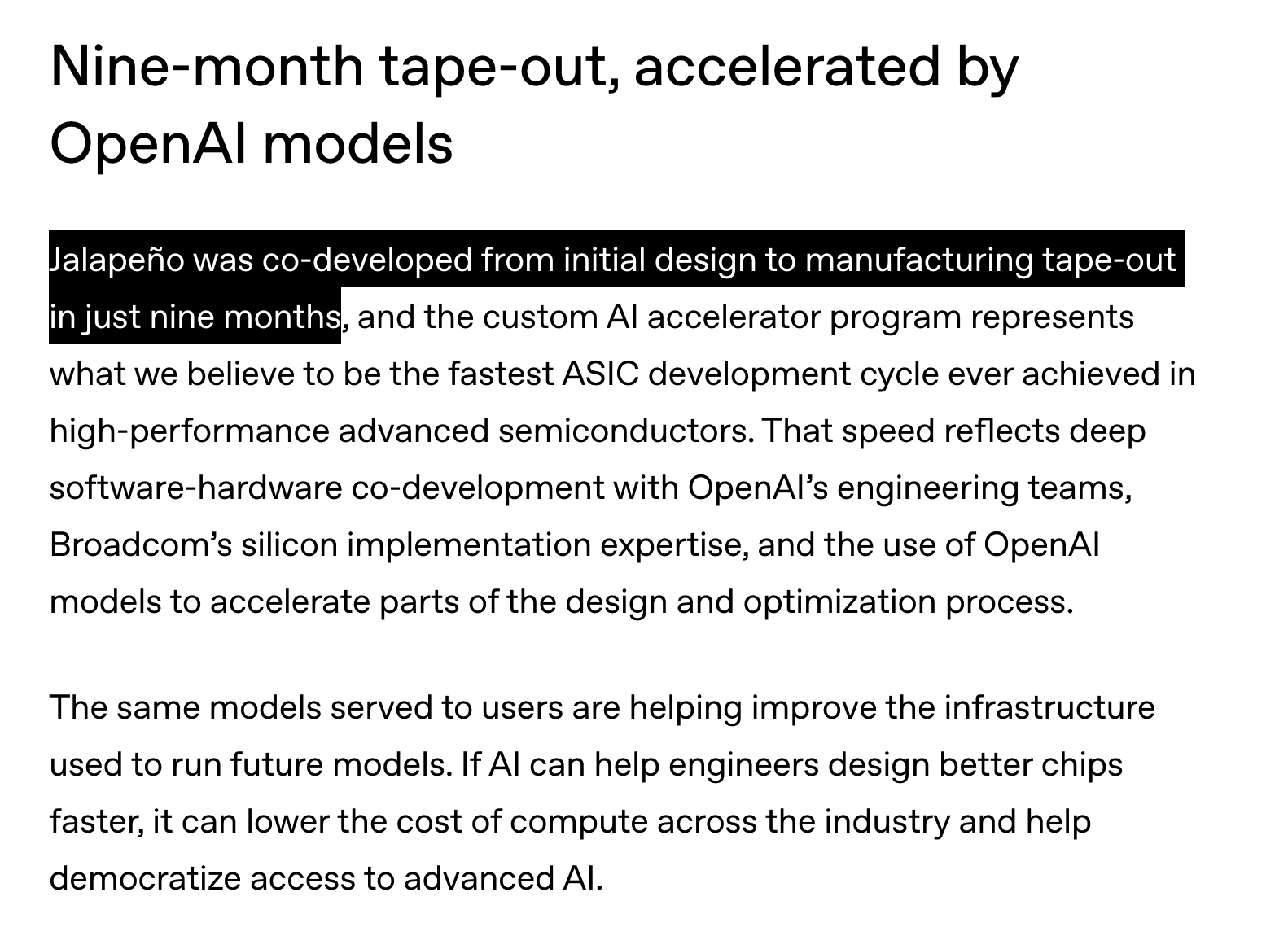
OpenAI unveiled Jalapeño, its first custom inference chip (built with Broadcom), and the wild part is the timeline: design to tape-out in nine months — the fastest ASIC cycle they've seen — because ChatGPT helped design it.
What they showed / shipped
- OpenAI announced Jalapeño, a chip purpose-built for the LLM workloads behind ChatGPT, Codex, and the API — its first move into making its own silicon.
- "Co-developed from initial design to manufacturing tape-out in just nine months" — claimed as the fastest ASIC development cycle ever in high-performance semiconductors, and AI helped do it.
- The pitch from OpenAI: if AI can help design better chips faster, it lowers the cost of compute across the whole industry.
Why it matters
- This is the feedback loop everyone's been waiting for — AI designing the hardware that runs AI. Cheaper inference compute eventually flows down to API prices you pay.
Sources
02
Computer-use agents go mainstream: Gemini 3.5 Flash + Perplexity for lawyers
Two computer-use drops landed the same day: Google put computer use in the cheap-and-fast Gemini 3.5 Flash, and Perplexity wired its Computer agent into the actual research databases lawyers live in.
What they showed / shipped
Why it matters
- Computer-use on a Flash-tier model means agentic UI automation is about to get cheap enough to run at scale — the cost wall that kept it a demo is coming down.
Sources
03
GPT-5.5 Instant gets an upgrade — better intent, better recs
OpenAI shipped a new GPT-5.5 Instant — its most-used model — tuned to read the intent behind a question and handle messy multi-constraint requests more reliably.
What they showed / shipped
- OpenAI updated GPT-5.5 Instant to better understand the intent behind a question and adapt its answer, plus handle complex constraints more reliably.
- Specifically better at shopping and local recommendations — the everyday consumer use case. Paid users first, free users the next day.
Why it matters
- 'most-used model' updates quietly move the floor for millions of apps built on the default tier — worth re-testing your prompts after a refresh like this.
Sources
04
Fable 5 looks set to come back — permanently in the plan
The latest Claude Code update is dropping hints that Fable 5 isn't just returning — it may be getting added permanently to the subscription plan, which would turn a yanked model into a standing one.
What they showed / shipped
Why it matters
- A model going from pulled-back to permanently-in-plan is the difference between 'fun demo' and 'thing you can build a product on' — stability matters more than peak benchmark.
Sources
05
a16z bets $200M on AI that does its own R&D
a16z led a $200M seed into Mirendil, a team out of Anthropic / DeepMind / xAI building a system that loops over AI research and engineering problems on its own — a coding agent for AI research that controls its own GPUs.
What they showed / shipped
- a16z led Mirendil's $200M seed: models that are expert at AI R&D, looping over research and engineering problems without human intervention.
- CEO Behnam Neyshabur on the goal — self-accelerating AI: direct a system toward a narrow angle and make fast, compounding improvement, the way a human expert deepens over time.
- The team comes out of Anthropic, Google DeepMind, and xAI — a $200M seed is a huge bet on 'AI improving AI' as a product, not a paper.
Why it matters
- 'a coding agent that controls its own GPUs and improves AI' is the recursive-self-improvement thesis getting venture funding — worth watching whether it ships or stays a pitch.
Sources
06
Anthropic accuses Alibaba of distilling Claude to train Qwen
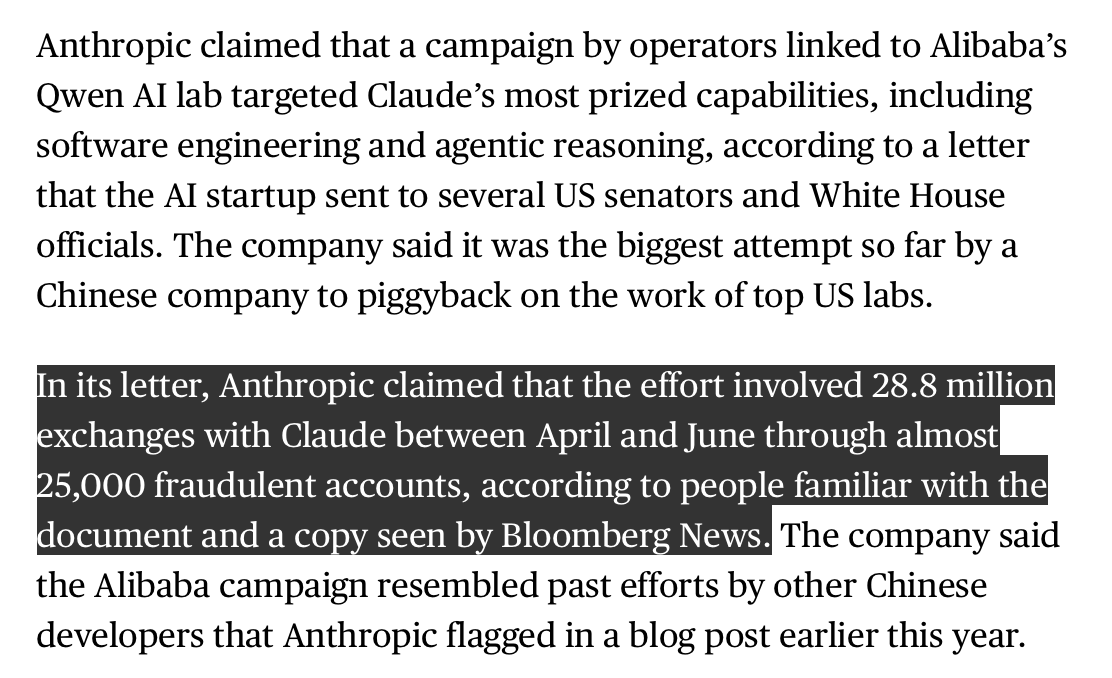
Anthropic told Bloomberg that Alibaba-linked operators ran ~25,000 fraudulent accounts to harvest 28.8M Claude exchanges between April and June — calling it 'adversarial distillation' to train rival models like Qwen on the cheap.
What they showed / shipped
- Anthropic accuses Alibaba of running ~25,000 fraudulent accounts that generated 28.8M Claude exchanges (Apr-Jun), targeting software-engineering and agentic-reasoning capabilities.
- Framed as 'adversarial distillation' — the pattern of harvesting frontier-model outputs to train rivals at a fraction of the cost. (Reuters, Bloomberg).
Why it matters
- Distillation-via-API is the open secret of the model race; a named, numbered accusation (28.8M exchanges) turns it from rumor into a real policy/security story.
Sources
07
The good-news beat: a $500M shot at ending the common cold and flu
Stripe, Anthropic, the OpenAI Foundation, the Flu Lab and Jane Street folks are putting $500M into Intercept — a philanthropic push to make respiratory infections like the common cold and flu a thing of the past, betting on broad-spectrum preventatives + air-cleaning tech.
What they showed / shipped
- Nan Ransohoff launched Intercept: a $500M initiative to make the common cold and flu "a thing of the past."
- The numbers that make it a real story, not a feel-good one: we spend ~5% of our lives sick from these viruses, they kill ~1M people a year, cost ~$600B annually in lost productivity, and periodically threaten civilization via pandemics.
- The bet is two product types — broad-spectrum preventatives and large-scale air-cleaning systems for schools/offices — areas historically underfunded because they don't fit normal philanthropic or commercial money.
- Anchor funders: Stripe, Anthropic, the Flu Lab, the OpenAI Foundation, and individuals from Jane Street.
Why it matters
- This is what 'AI/tech money going somewhere genuinely good' looks like — a concrete counter-example to the bubble-and-doom narrative dominating the timeline.
Sources
08
Forward signal: the EU is funding its own open 400B frontier model
The EU is funding its own open-source 400B+ frontier model, built on European supercomputers — a sovereignty + open-weights play worth tracking even before any weights ship.
What they showed / shipped
Why it matters
- A sovereign open 400B model would be a genuinely new option in the open-weights stack — worth watching whether it ships usable weights or stays a press release.
Sources