01
Claude Fable 5.2 and Mythos 5.2 land, with a new high on ARC-AGI-3
Anthropic shipped two new models today and the first third-party numbers say Fable 5.2 leads on several boards, with a caveat that early scores are mostly vendor and fan reported.
What they showed / shipped
- Anthropic announced Claude Fable 5.2 and Claude Mythos 5.2 as available now AnthropicAI on X, with the longer write-up on anthropic.com.
- Artificial Analysis lists Fable 5.2 at 65, the highest score on its index so far Artificial Analysis.
- Perplexity says Fable 5.2 hit a record 0.851 on its WANDR benchmark at $14.51 per task, a Pareto frontier claim on performance and cost Perplexity on X. That is Perplexity's own benchmark, so treat it as first party.
- A Reddit post reports a new high score on ARC-AGI-3 in the standard harness r/singularity. Confirm on the ARC Prize leaderboard before quoting a number.
- Demo reels: an operating system built from scratch r/singularity and a playable Gears of War style game from a 3 line prompt, per Matthew Berman after 100 billion tokens of testing r/singularity.
- Press frames the launch around recursive self improvement concerns TechCrunch.
- 📌 On the radar: Inkling 2 Small is free for a limited time on opencode and live on OpenRouter Thinking Machines on X.
Why it matters
- Fable 5.2 is already inside Perplexity Computer and Teammates, so you can try it today without touching an API.
Sources
02
Claude cracks two open black-hole physics questions
A report says Claude settled a 23 year old question about black hole formation in toy universes and found the exact limits of a 15 year old method used to rule out quantum gravity theories.
What they showed / shipped
- Claim: one result on whether black holes form suddenly in models of tiny universes, and one on where a method for ruling out quantum gravity theories stops working r/singularity. Secondhand via Reddit, the underlying paper was not checked.
- Separately, Anthropic published a test of Claude on real world electronics design Anthropic research.
Why it matters
- The electronics write-up is a concrete look at where an agent helps and fails on hardware work.
Sources
03
Roblox is where AI game making shows up in the numbers
a16z charts show AI game development on Roblox taking off, while solo builders ship AI made games that real people play.
What they showed / shipped
- a16z: a growing share of top Roblox games launched in the last 90 days, Roblox MCP daily users are climbing, more dev time is spent with AI and asset uploads are rising a16z on X 📊.
- The a16z hosts add a caution that most vibe coded apps elsewhere have no users, with gaming and Roblox as the outlier a16z on X.
- A solo dev's infinite Backrooms game, where Claude Opus 5.5 keeps generating rooms and a correction loop fixes broken ones, reported 35,000 players and about 9,600 hours played in under 36 hours minchoi on X.
- A Skyrim modder used AI to reverse engineer the 15 year old engine for terrain editing and modular building r/singularity, and Meng To built a Baldur's Gate 3 inspired RPG with Claude Opus 5.5 and Three.js r/singularity.
Why it matters
- A platform with built in distribution and an MCP is where AI built games find players.
Sources
04
Creator tools: Runway Sightline, Instagram Effect Builder, Disney and Adobe
Three launches push generative tools closer to everyday filmmaking and filters.
What they showed / shipped
- Runway Sightline makes a 360 panorama of any location, lets you frame shots from any angle with a consistent environment, and exports the panorama for 3D Runway on X.
- Instagram's Effect Builder makes filters from AI prompts The Verge.
- Disney and Adobe are building generative AI tools together The Verge. Details are thin in the headline, read the piece before using.
Why it matters
- A consistent 360 environment exported to 3D is a reusable asset, not just a clip.
Sources
05
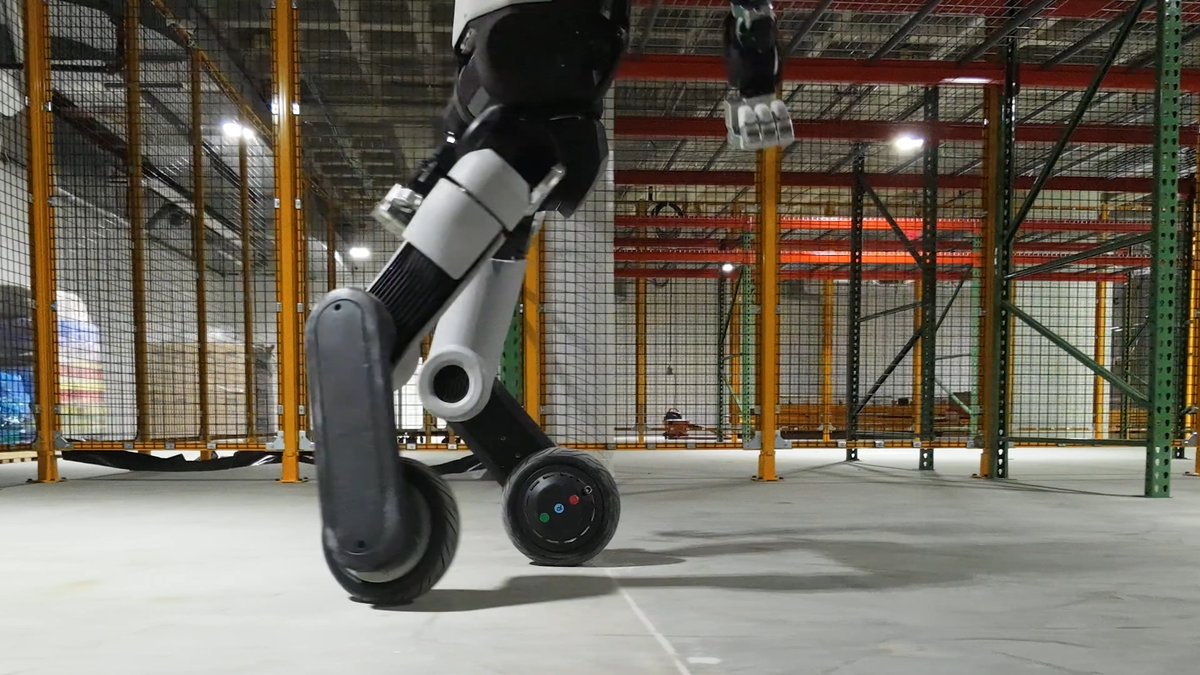
Boston Dynamics puts wheels on Atlas to test a learned controller
Atlas on wheels is a deliberate test of how faithfully an RL whole body controller transfers to real actuators running at the edge.
What they showed / shipped
- Boston Dynamics says the wheeled Atlas experiment tests an RL whole body controller on real actuators outside the lab Boston Dynamics on X.
- On the chip side, DeepX claims inference of models up to 100B parameters under 5 W with its second gen chip, a vendor claim EE Times.
Why it matters
- Sim to real transfer of learned controllers is the bottleneck for every humanoid, and this is a direct test of it.
Sources
06
OpenAI Control Room can halt model output within 35 seconds
OpenAI describes a central system that tracks every research inference workload and can stop jobs fast on safety or security concerns.
What they showed / shipped
- Control Room connects research inference workloads including agentic sampling for training and evaluation, works with misalignment monitoring, and halts output within 35 seconds of a decision to intervene OpenAI on X.
- Context: the Fable and Mythos 5.2 launch is being covered with recursive self improvement worries TechCrunch.
Why it matters
- A checkable number (35 seconds) and a named mechanism, which is what separates this from safety theater.
Sources
07
New silicon and a lightweight agent model: TPU 8tx, 8i Max, Meta Muse Ember
Google split its next TPUs by job, and Meta released a small model aimed at running agent steps.
What they showed / shipped
- Google announced TPU 8tx for secure and confidential AI workloads and TPU 8i Max for massive context windows Google blog.
- Meta released Muse Ember, a lightweight model for agent execution TechCrunch. Specs and weights availability not confirmed in the headline.
Why it matters
- Chips for long context and chips for confidential workloads point to where inference costs and enterprise adoption go next.
Sources
08
Your data is training AI: Gemini annotators and sleep EEG
Two privacy stories show personal data reaching AI pipelines in ways users did not expect.
What they showed / shipped
- A GitHub write-up claims Google Gemini routes personal Drive files and emails to human annotators GitHub. Community claim, not confirmed by Google.
- Tom's Hardware reports sleep wearables are training AI on brainwave data, with tens of millions of hours of EEG harvested without explicit consent Tom's Hardware.
Sources
 x/@perplexity_ai
X@perplexity_ai
♥ 267↻ 15👁 23K
 x/@AravSrinivas
X@AravSrinivas
♥ 171↻ 12👁 14K
hn/Claude Fable 5.2 Scores 65 on Artifici… @theanonymousone
♥ 269 x/@techcrunch.com
techcrunch.com
 anthropic.com
 The Verge
theverge.com