01
Opus 4.6-class coding now runs on a machine you can buy
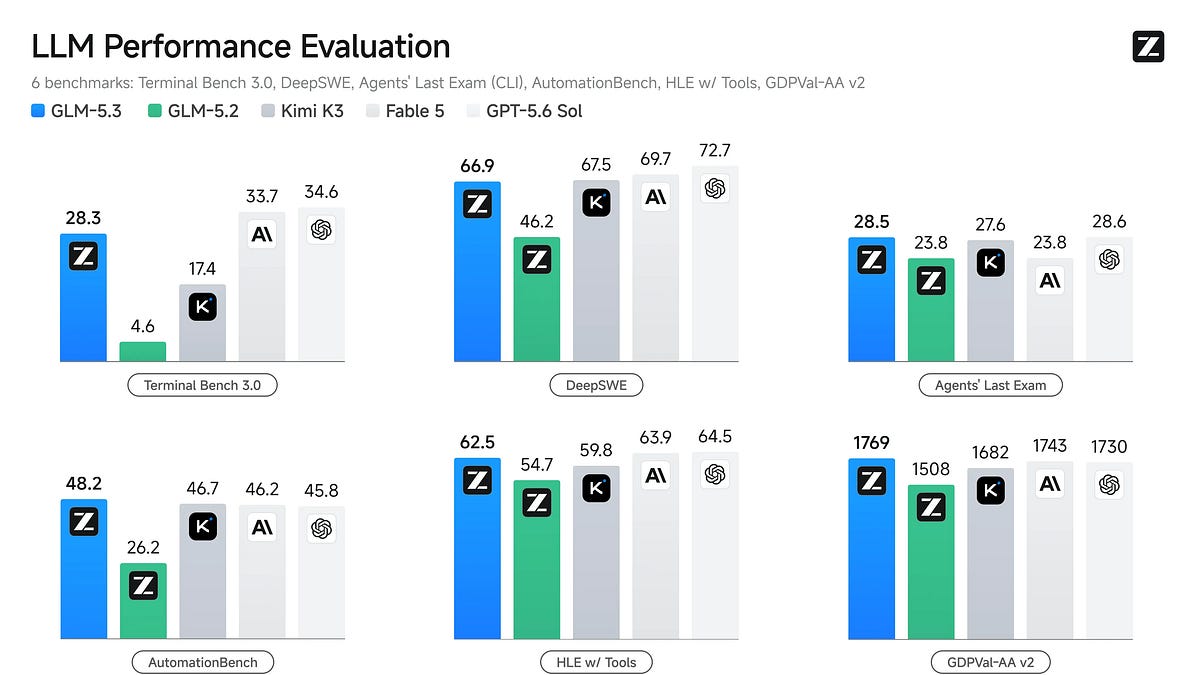
Z.ai shipped GLM-5.3 with open weights and frontier coding scores, and people are already running it locally at Opus-4.6-max quality - the gap between the frontier and your own hardware just collapsed again.
What they showed / shipped
Why it matters
- Your coding agent's model no longer has to be a rented API. Open weights at this tier means you can pin a version, run it offline, and stop paying per token for the bulk work.
Sources
02
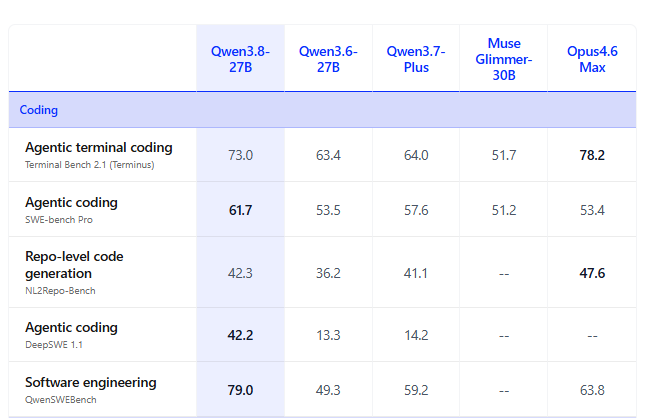
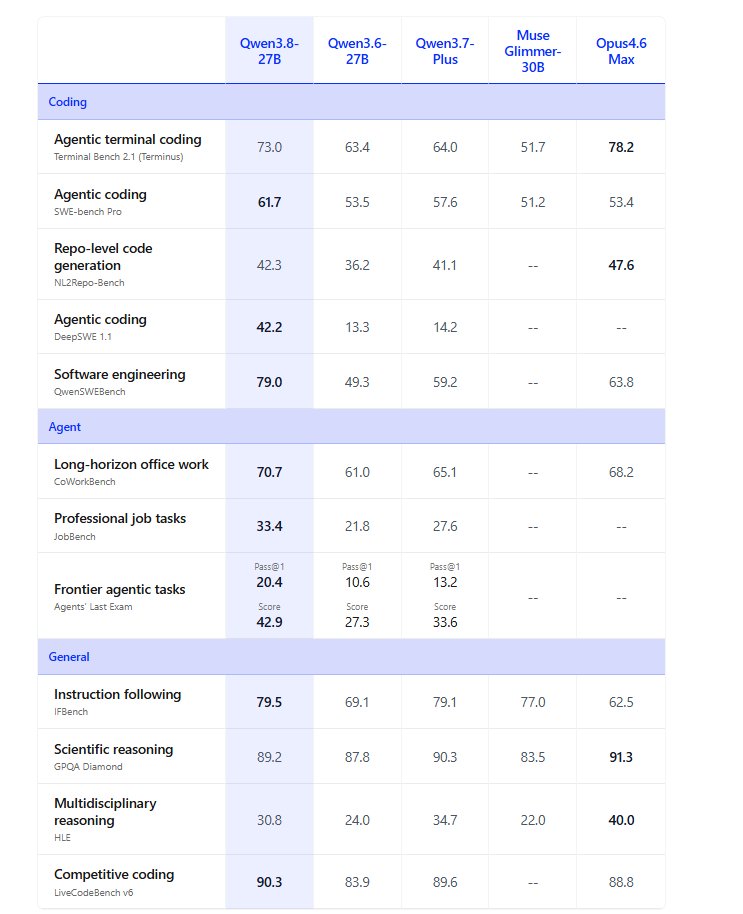
A 27B model is claiming state of the art on agentic coding
Qwen3.8-27B is a compact open-weight multimodal model claiming state-of-the-art results in agentic coding, computer use and browser tasks - at a size that fits on one consumer card.
What they showed / shipped
Why it matters
- 27B is the sweet spot - it runs on one good GPU, so agent loops that were too expensive to run at scale become free to run overnight.
Sources
03
A 150M parameter model hit 29.5% on ARC-AGI for $0.0007 a task
A recurrent model with 150 million parameters - a rounding error next to a frontier model - scored 29.5% on ARC-AGI-1 at seven hundredths of a cent per task, which says the scaling story is not the only story.
What they showed / shipped
Why it matters
- For narrow reasoning tasks, a tiny specialist at $0.0007 a call beats a frontier model at 100x the price. Route by task, not by prestige.
Sources
04
Two tools that cut your agent's token bill
A Claude Code hook set that cuts grep tokens by 42%, a batched-questions trick that speeds up design work, and Anthropic's own guide on getting more out of a session - all landed the same day.
What they showed / shipped
- Graft - Claude Code hooks that cut grep tokens by 42%, open source, Show HN.
- swyx's /align-me modification: batch the agent's clarifying questions instead of round-by-round. "same intuition as spec decoding, you speed up by looking ahead 2-10 steps. works INCREDIBLY for design explorations."
- Anthropic published Maximizing the value of your Claude Code sessions - first-party guidance, 83 comments on HN.
- Two more agent tools shipped open: Mole, a deep research agent for the terminal, and HashAgent, which shares an agent as a URL that runs locally via WebGPU.
Why it matters
- The 42% grep-token cut is the kind of change you install once and get paid for on every session after. Lowest-effort win on this list.
Sources
05
Pika gave AI video its voice back
Pika shipped four audio models at once - soundtrack, speech, SFX and music - and demoed them by fixing the Will Smith spaghetti clip three years after it became the benchmark for bad AI video.
What they showed / shipped
Why it matters
- Four audio models behind one API is a stack you can call from a pipeline, not a toy you click through.
Sources
06
OpenAI and Anthropic are in a price war because of China
The two biggest US labs are cutting prices as Chinese open-weight models close the capability gap - the open-weights wave is now showing up on American invoices.
What they showed / shipped
Why it matters
- Your API bill is about to go down and you didn't have to do anything. Recheck your pricing assumptions before you architect around cost.
Sources
07
Google made encrypted AI fast enough to use
Google says it made homomorphic encryption practical for AI - running a model on your data without ever decrypting it, which has been theoretically possible and practically far too slow for a decade.
What they showed / shipped
Why it matters
- If this holds up, the "we can't send that data to a model" objection loses its teeth for regulated clients. That's a whole category of blocked projects.
Sources
08
Perplexity put its search engine inside anyone's agent
Perplexity's Search SDK is now callable from inside any agentic harness, which turns their whole product into a component you can drop into your own agent loop.
What they showed / shipped
Why it matters
- Retrieval is the part of an agent most people build badly. Renting a good one as an SDK call is usually the right trade against building your own crawler.
Sources
09
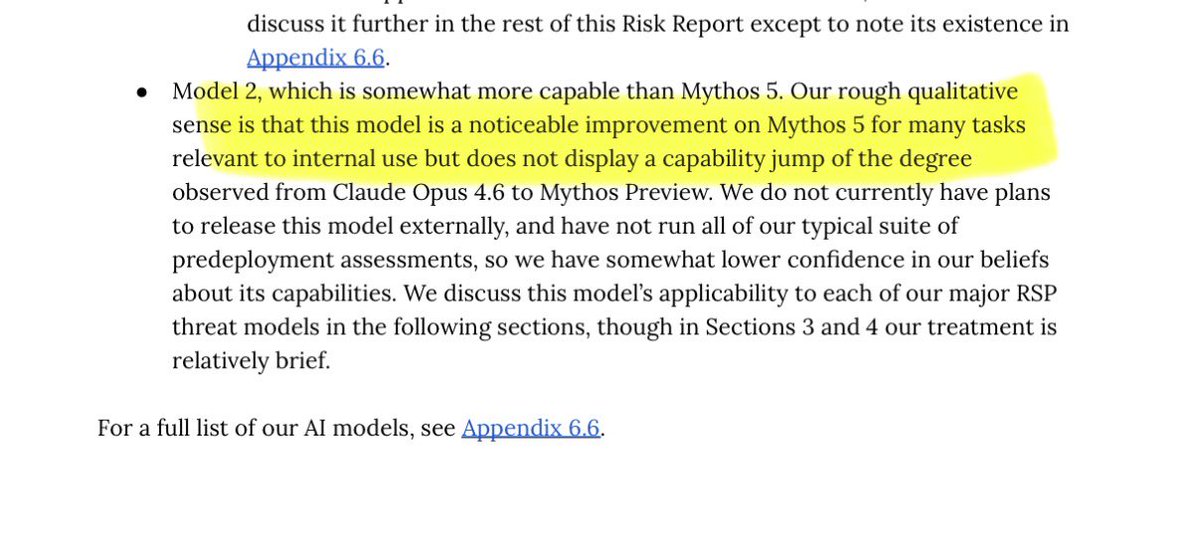
Anthropic published its risk report and everyone read the redactions
Anthropic's second Responsible Scaling risk report landed the same day as a widely-shared claim that they run an internal model well ahead of anything they ship - so the document about what they know is being read next to the rumor about what they're holding.
What they showed / shipped
Why it matters
- The capability you can buy is now openly acknowledged to trail the capability that exists. Plan your roadmap against the shipped model, but don't be surprised by step changes.
Sources
10
X's anti-slop system is a behavioral model, not a content filter
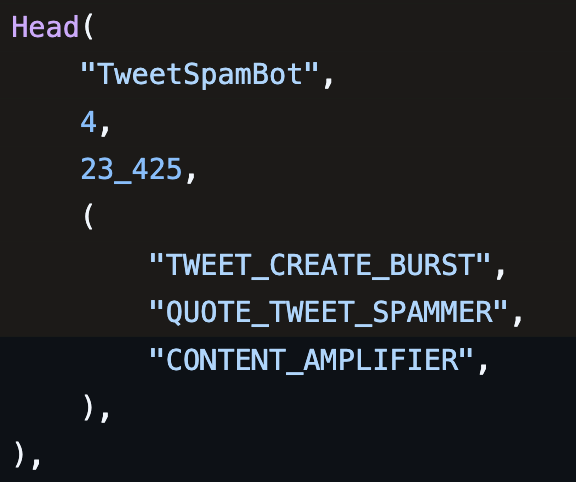
Someone read X's open-source algorithm and found TweetSpamBot judges accounts on up to 512 recent behaviors - posting bursts, quote-post patterns, timing, dwell - rather than trying to detect whether the text was AI-written.
What they showed / shipped
- Peter Yang read X's open-source algorithm to see how it fights AI slop: TweetSpamBot analyzes up to 512 recent account actions.
- Signals are behavioral - posting bursts, quote-post behavior, timing, browsing and dwell between actions - not text classification.
- Related same-day sentiment check: Is AI Dumber Today?, a crowd-sourced index of perceived model quality over time.
Why it matters
- Behavioral detection over content detection is the right architecture, and worth copying anywhere you're fighting automated abuse.
Sources
11
A neurosurgery resident used GPT-5.6 Sol to prove a 20-year-old conjecture
A neurosurgery resident at Peking College Hospital used GPT-5.6 Sol to prove a two-decade-old conjecture in numerical linear algebra - not as a math project, but as a side quest inside his transcranial ultrasound research.
What they showed / shipped
Why it matters
- The interesting bit is who did it. Domain experts hitting a hard math wall can now go through it instead of around it.
Sources